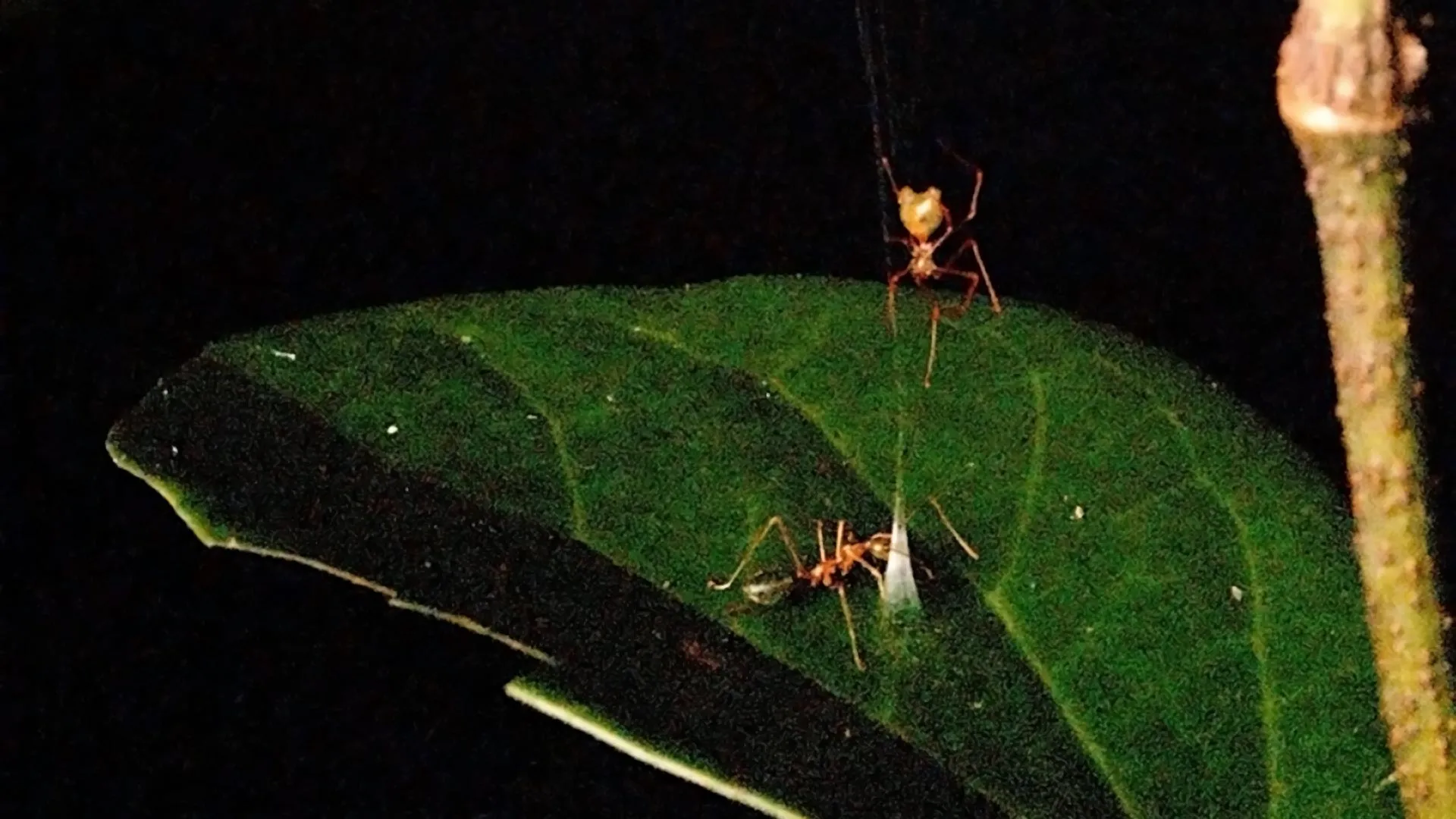
Researchers have discovered a ballista spider that deploys a spring-loaded silk trap to ensnare aggressive green tree ants. The trap works through an ingenious trigger mechanism: when an ant walks across the web, it activates the spring, catapulting the insect directly into the spider's lethal embrace.
The spider, part of the Salticidae family, constructs its web using specialized silk threads under tension. This prestressed system stores mechanical energy, similar to a loaded crossbow. When an ant disturbs the web's surface, it releases the tension, launching the prey toward the spider's waiting fangs. The ant becomes the unwitting architect of its own capture.
This hunting strategy represents an adaptation to a specific ecological challenge. Green tree ants are highly aggressive defenders of their territories and move with speed that makes conventional web-catching difficult. By forcing the ant to trigger its own trap, the spider bypasses the ant's natural vigilance and escape responses.
Ballista spiders occupy a small niche in the predator world. Their spring-loaded mechanism differs fundamentally from orb-weaver spiders, which rely on sticky silk and passive entanglement. The ballista approach requires precise engineering, with the spider calculating tension levels and anchor points to generate sufficient force while maintaining structural integrity.
The discovery adds to our understanding of predator-prey evolution. Many ant species demonstrate remarkable intelligence and coordination in defense, yet the ballista spider circumvents these advantages through mechanical innovation rather than chemical or behavioral adaptation. This represents convergent evolution of engineering principles found elsewhere in nature, like the mantis shrimp's punch or the archerfish's ballistic shot.
The research underscores how selective pressure in localized environments drives unexpected solutions. The ballista spider's existence in regions where green tree ants dominate suggests the trap evolved specifically as a response to this particular prey. Such examples illuminate