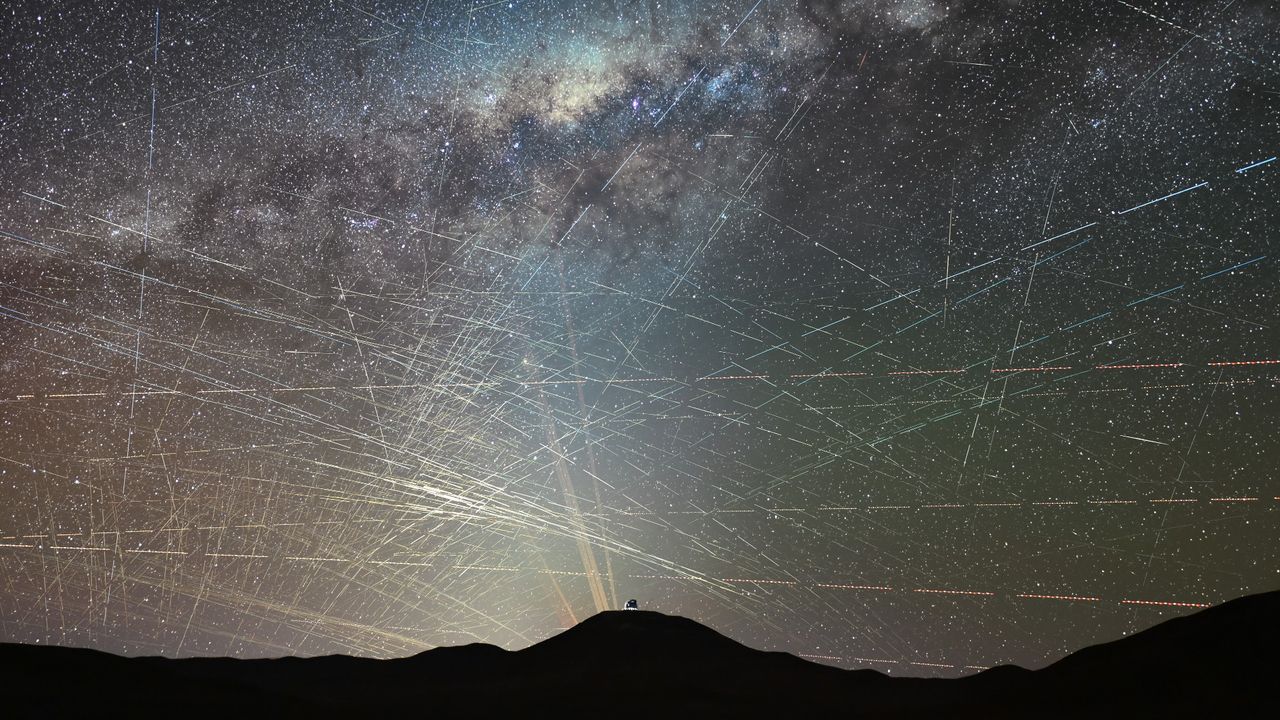
Astronomers face an unprecedented threat to ground-based telescope observations as satellite mega-constellations rapidly expand. If orbital populations exceed 100,000 satellites, researchers warn that Earth-based astronomy could become functionally impossible.
The problem stems from reflective light scattered by satellites passing through telescope fields of view. Current orbital populations, dominated by companies like SpaceX's Starlink and Amazon's Project Kuiper, already cause image degradation. These constellations orbit at altitudes of 400 to 1,200 kilometers, positioning them to interfere with ground observations during twilight hours when telescopes operate most productively.
Researchers have documented increasing satellite interference in recent years. Wide-field survey telescopes, particularly those designed to map the night sky and detect transient phenomena like supernovae or asteroids, face the greatest vulnerability. The problem compounds as companies propose deploying millions of additional satellites for global internet coverage.
The Vera Rubin Observatory in Chile, scheduled to begin operations soon, represents a case study in this challenge. Its wide-field design makes it exceptionally sensitive to satellite trails crossing its images. Astronomers have called for coordinated mitigation strategies, including satellite brightening reduction, orbital altitude adjustments, and preferential launch timing.
Industry and science have begun preliminary collaborations. SpaceX has tested darker satellite coatings and adjusted orbital inclinations. However, these measures provide only partial solutions. No comprehensive international framework currently governs satellite deployment density or orbital coordination.
The conflict highlights a broader tension between terrestrial connectivity ambitions and astronomical research. While satellite internet serves critical infrastructure needs, astronomers argue that losing optical and infrared observations would damage fundamental science, including exoplanet detection, cosmology studies, and near-Earth object tracking.
Some researchers propose alternative approaches: relocating telescopes to sites with reduced satellite visibility, developing advanced image processing techniques to remove satellite