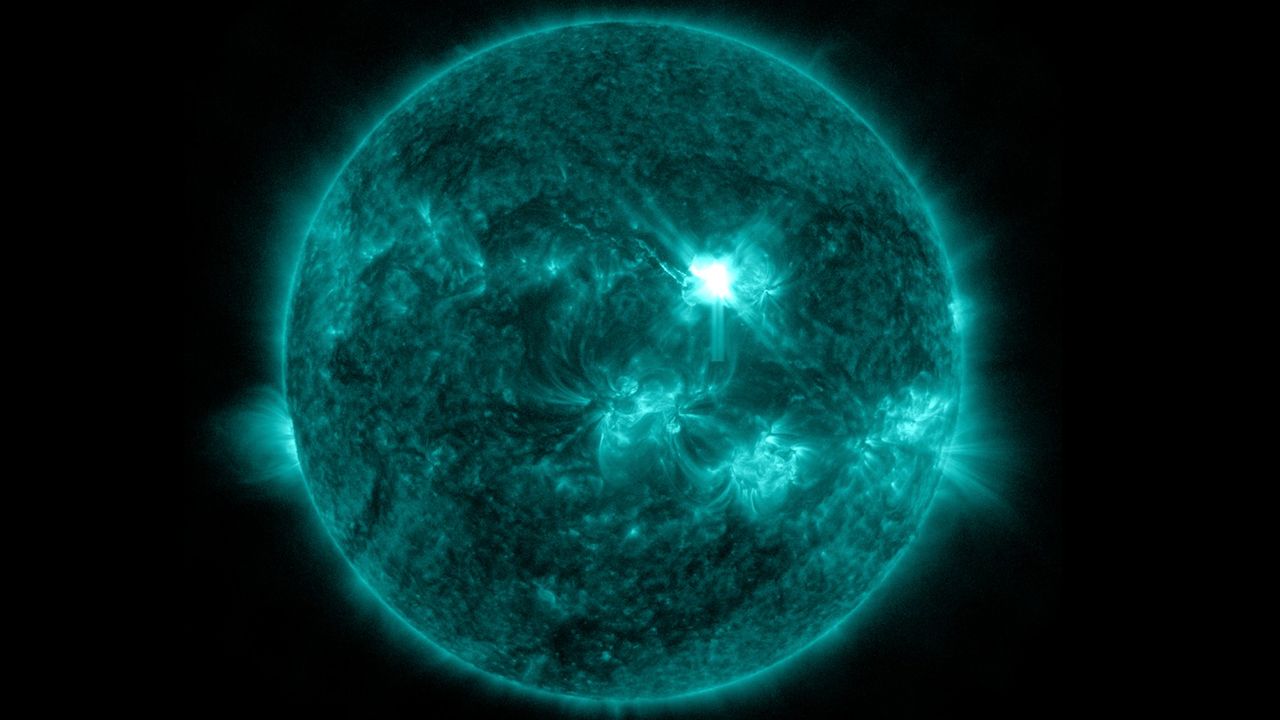
The Sun released an X1.1-class solar flare on July 1, triggering radio blackouts across Earth's daylight hemisphere and launching a coronal mass ejection (CME) toward the planet. The flare briefly disrupted radio communications as energetic radiation swept across affected regions. Forecasters predict the CME will arrive at Earth on July 3, potentially sparking vivid auroral displays over the northern hemisphere during the July 4 weekend.
X-class flares rank among the most powerful solar events. The X1.1 designation indicates a flare with considerable energy release from the Sun's magnetic field. These eruptions accelerate charged particles that can interfere with radio signals used by aircraft, maritime vessels, and emergency services. The accompanying CME consists of plasma and magnetic field material ejected from the Sun's corona.
When a CME reaches Earth's magnetosphere, it compresses and distorts the protective magnetic bubble surrounding the planet. This interaction can trigger geomagnetic storms that energize particles in the upper atmosphere. Those energized particles collide with oxygen and nitrogen, producing the characteristic green and red light of auroras. Strong geomagnetic storms push auroras farther south than usual, making them visible at higher latitudes than typical.
The Space Weather Prediction Center (NOAA) and other monitoring agencies track solar activity continuously. Forecasters calculate CME travel times by measuring eruption velocity and distance. The July 3 arrival prediction carries standard uncertainty, as CME speeds and trajectories can vary based on solar wind conditions encountered during transit.
For skywatchers in northern latitudes, a geomagnetic storm could deliver an unexpected bonus for Independence Day celebrations. The aurora's appearance depends on storm intensity, cloud cover, and local light pollution. Those in Alaska, northern Canada, and Scandinavia have the highest probability of viewing displays. Even viewers