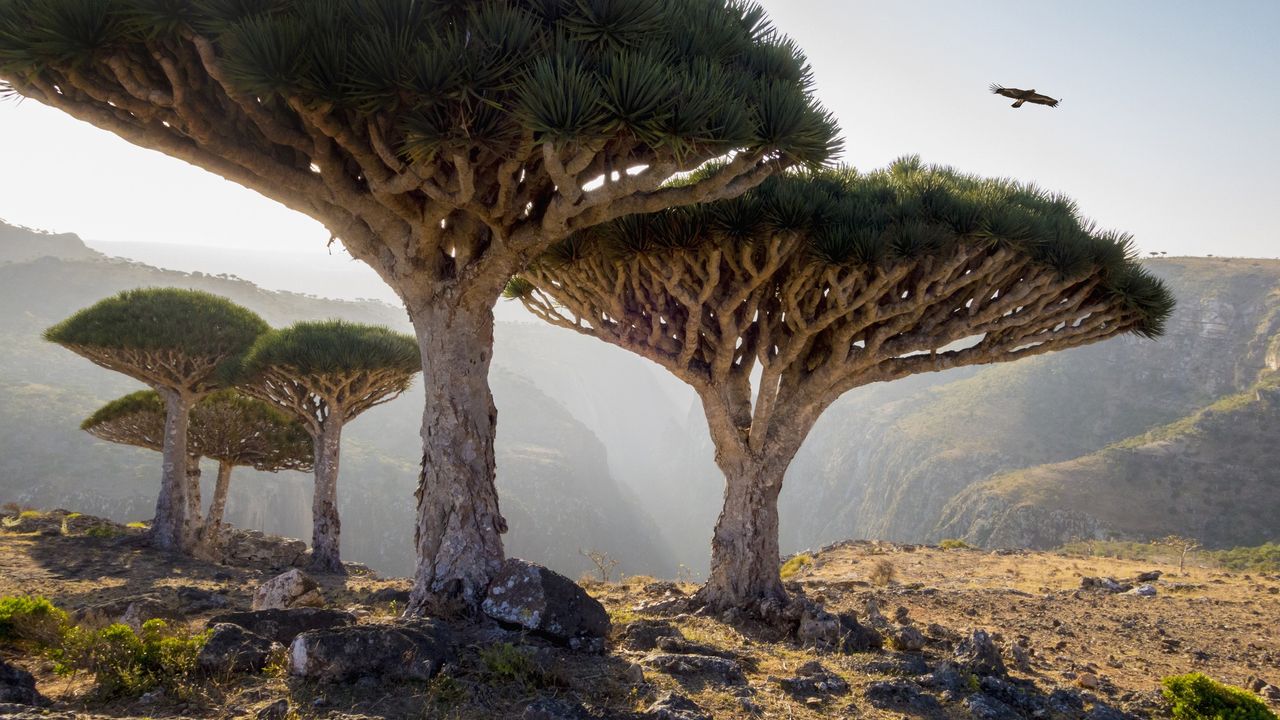
The Socotra Archipelago, situated in the northwest Indian Ocean off Yemen's coast, shelters one of Earth's most distinct ecosystems. Hundreds of animal and plant species exist nowhere else on the planet, making these islands a biodiversity hotspot of global importance.
The archipelago's most visually striking inhabitants are its unusual trees. Dragon's blood trees display a distinctive umbrella-like canopy and produce deep red resin used historically in medicine and dyes. Bottle trees store water in their swollen trunks to survive the islands' arid climate. Cucumber trees, named for their elongated fruit, contribute to Socotra's reputation as a living botanical museum.
This endemism rate, where species exist only in one location, ranks exceptionally high among world ecosystems. The islands' geological isolation and harsh environmental conditions, including extreme heat and seasonal monsoons, created a crucible for unique evolutionary adaptation over millions of years. The archipelago's remote position in the Indian Ocean prevented colonization by species from mainland Africa and Asia, allowing endemic lineages to diversify unchecked.
Scientists recognize Socotra as a biodiversity hotspot comparable to Madagascar and the Galápagos Islands in terms of ecological uniqueness. The fauna matches the flora's distinctiveness, with endemic reptiles, arthropods, and birds found across the islands' varied habitats, from coastal zones to mountains.
The islands face mounting conservation challenges. Climate change threatens both plant and animal populations adapted to specific environmental conditions. Political instability in Yemen compounds these pressures, limiting scientific study and conservation efforts. The archipelago's tourism remains limited, partly due to regional conflict, which has provided some protection through isolation.
International conservation organizations monitor Socotra's status closely. UNESCO designated the islands as a Natural World Heritage Site, recognizing their unparalleled ecological value. Researchers continue documenting species and