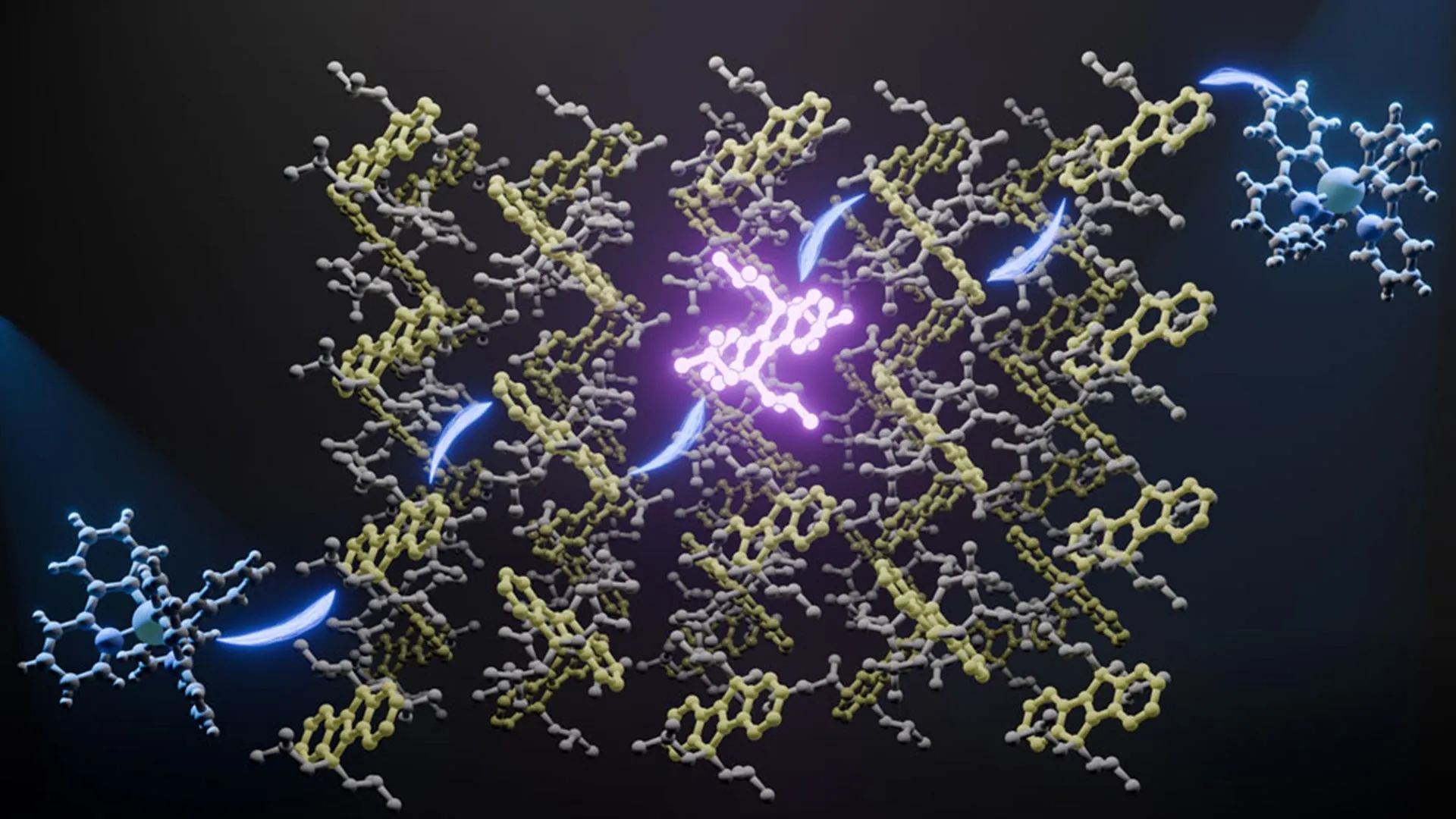
Researchers have developed a solid-state material that converts visible sunlight into ultraviolet light, solving a persistent challenge in photochemistry and materials science. This upconversion process, which shifts lower-energy photons to higher energies, has eluded effective implementation for decades despite its obvious applications.
The material achieves what scientists call "photon upconversion," absorbing visible light and re-emitting it as UV radiation with greater energy. This capability opens pathways for solar-powered air purification systems that rely on UV's germicidal properties, without requiring electrical inputs. Industrial applications extend to solar-driven chemistry and advanced manufacturing processes that currently depend on artificial UV sources or grid-powered systems.
Previous attempts at photon upconversion materials faced fundamental obstacles. Most approaches required either intense laser light to function or suffered from low efficiency when exposed to ordinary sunlight. This new solid-state formulation overcomes both constraints, operating under ambient sunlight conditions with practical conversion rates.
The breakthrough carries particular significance for sustainability. Current UV applications consume substantial electrical energy, especially in water treatment facilities and pharmaceutical manufacturing. A sunlight-activated material could substantially reduce operational costs and carbon footprints in these industries. Air purification systems integrating this material would function passively during daylight hours, requiring no additional power infrastructure.
The work represents incremental but consequential progress rather than revolutionary change. While the efficiency remains below what laboratory lasers achieve, the material's ability to function under natural solar radiation makes it the first practical candidate for real-world deployment. Researchers likely face remaining hurdles in scaling production, optimizing conversion efficiency further, and verifying long-term durability under continuous sunlight exposure.
The research team has not yet disclosed specific material composition or institutional affiliations in available sources, limiting assessment of the work's peer review status and reproducibility timeline. Publication in a peer-reviewed journal remains necessary before the scientific community