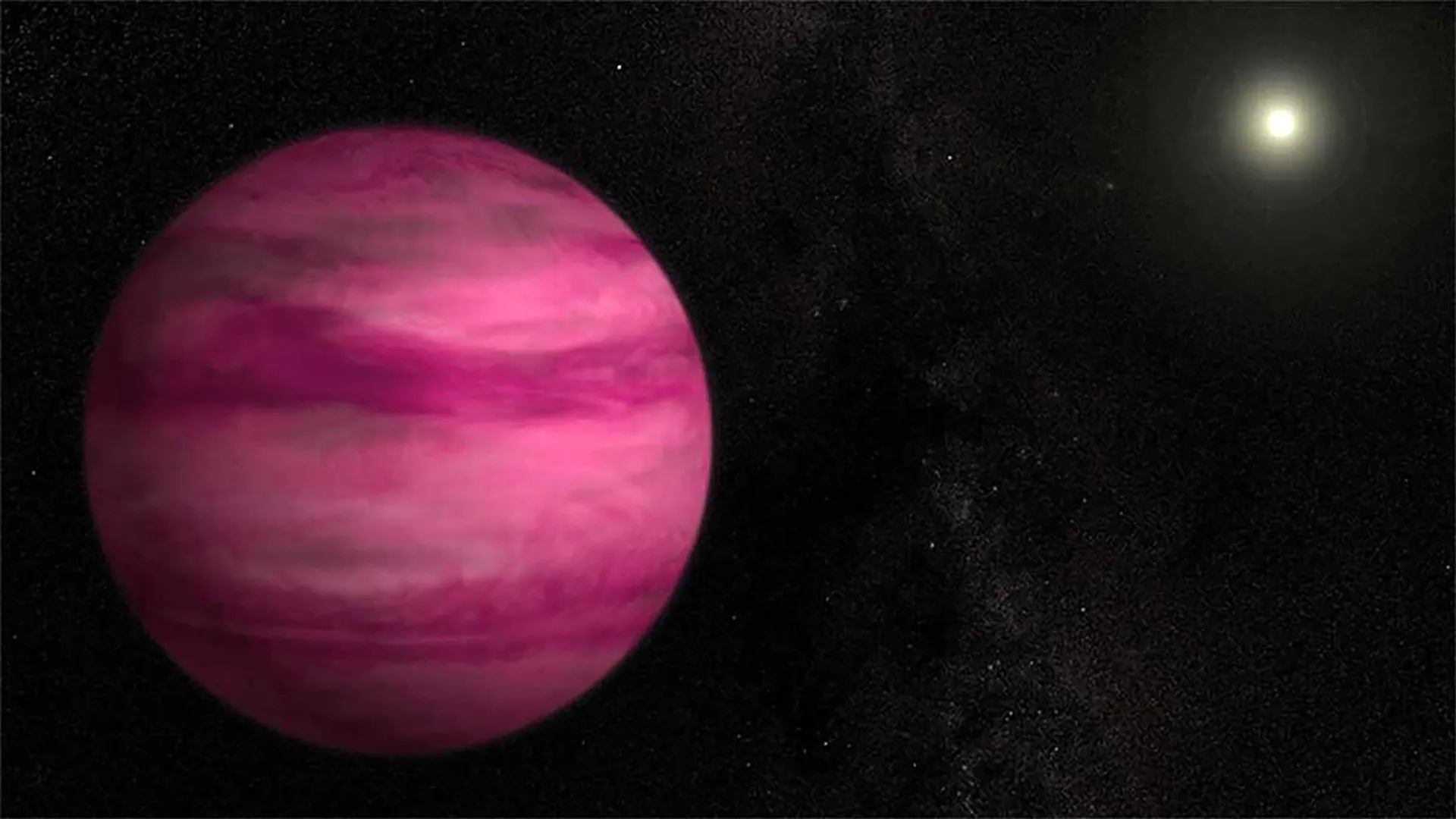
The James Webb Space Telescope has solved a decade-long puzzle about GJ 504b, a distant exoplanet 57 light-years away known as the "Pink Planet" for its unusual coloration. Astronomers detected water vapor, methane, carbon dioxide, and ammonia in its atmosphere, along with salt clouds, the first direct confirmation of such features in this type of world.
GJ 504b orbits a star in the constellation Virgo and stands out among exoplanets for its distinctive pink hue, which puzzled researchers since its discovery. The planet's composition and atmospheric properties remained largely unclear until Webb's advanced infrared spectroscopy capabilities allowed scientists to analyze light passing through the atmosphere with unprecedented precision.
The discovery of salty clouds marks a watershed moment in exoplanet atmospheric research. Salt compounds had been theoretically predicted in planetary atmospheres but never definitively detected before in such objects. The presence of salt alongside water vapor and other compounds suggests complex chemical processes occurring in the planet's upper atmosphere.
GJ 504b appears to be a young, massive gas giant, roughly nine times Jupiter's mass. Its youth makes it an ideal laboratory for understanding planetary formation and evolution. The pink coloration likely results from particles or chemical compounds in its atmosphere absorbing certain wavelengths of light, though researchers continue investigating the precise mechanism.
Webb's infrared capabilities proved essential for this discovery because salt compounds emit and absorb infrared radiation distinctly. Ground-based telescopes lack the sensitivity to detect such subtle spectral signatures.
The findings reveal that exoplanet atmospheres contain greater chemical diversity than previously confirmed. Understanding these compositions helps astronomers refine models of planetary formation and atmospheric evolution. The detection methods developed for GJ 504b will guide future observations of other distant worlds.
This work demonstrates Webb's transformative impact on exoplanet science, moving beyond detecting mere