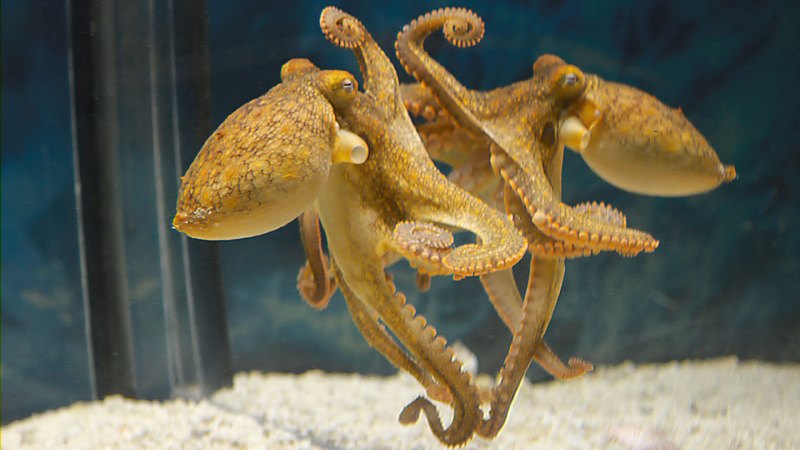
Octopuses possess a cognitive ability previously thought exclusive to a handful of mammals and birds: they can understand mirror reflections and use them to locate objects in their environment. Researchers conducting experiments with octopuses and mirrors have now confirmed this capacity extends beyond simple self-recognition.
In the study, scientists presented octopuses with mirrors while hiding food or prey items like crabs just out of direct line of sight but visible only in the mirror's reflection. The octopuses successfully located and retrieved the hidden items by using the mirror image as a guide, demonstrating they understood that reflections represent real objects in space.
This finding reveals octopuses process visual information in ways comparable to some vertebrates. Mirror understanding typically requires an animal to integrate information from multiple sensory systems and form spatial representations of their environment. Mammals like dolphins and great apes accomplish this task. Corvids and some parrots also show this capability. Octopuses now join this exclusive group.
The research has implications for understanding cephalopod intelligence. Octopuses evolved their nervous systems independently from vertebrates, following a completely different evolutionary path. Yet they still developed comparable problem-solving abilities and spatial reasoning. This convergent evolution suggests that certain types of intelligence emerge across distantly related species because they solve real survival challenges.
The experiments build on previous work showing octopuses can use tools, recognize individual humans, and solve complex puzzles. Their distributed nervous system, with neural tissue concentrated in their arms rather than solely in their central brain, may enable flexible, adaptive responses to novel situations like mirror navigation.
The practical application extends to prey capture. In their natural habitat, octopuses hunt crustaceans like crabs that hide in crevices and rocky spaces. Using reflections off water surfaces or rocks could provide hunting advantages when prey remains hidden from direct view. This cognitive skill thus represents an evolutionary adaptation suited to the octopus lifestyle in