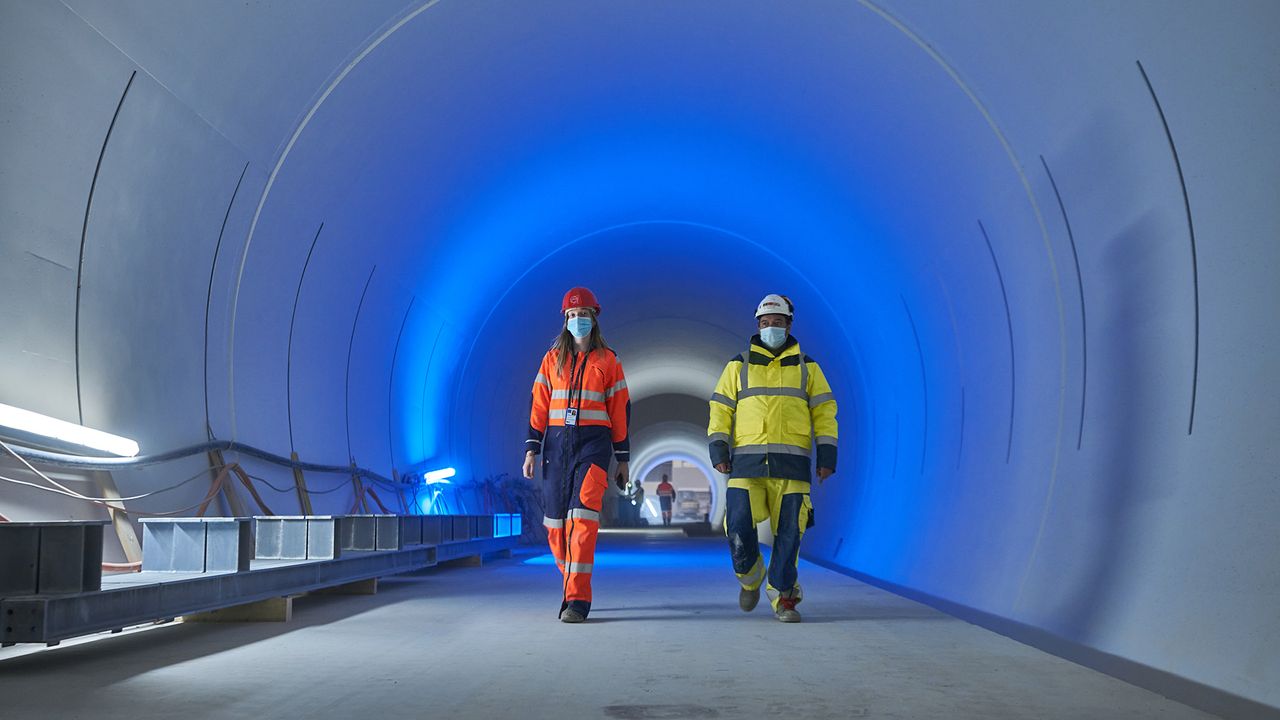
CERN has shut down the Large Hadron Collider for a comprehensive four-year upgrade designed to boost its sensitivity tenfold. The facility, the world's largest particle accelerator, will remain offline until 2030 while engineers and physicists implement improvements that transform it into its most powerful configuration to date.
The upgrade addresses fundamental limitations of the current LHC, which has operated since 2008. The enhanced sensitivity will allow researchers to detect rare particle interactions and phenomena that occur too infrequently to observe with the machine's existing capabilities. This increased precision opens new avenues for exploring physics beyond the Standard Model, the framework that describes known particles and forces.
The LHC operates by colliding protons at nearly the speed of light, recreating conditions similar to the first moments after the Big Bang. Previous runs have yielded landmark discoveries, including the Higgs boson in 2012. However, many fundamental questions remain unanswered. The upgraded machine will generate collision data at rates and intensities unavailable before, enabling physicists at CERN to investigate dark matter candidates, rare decay processes, and other mysteries in particle physics.
The four-year closure allows teams to replace and improve detector components, upgrade magnet systems, and enhance computational infrastructure. These modifications require complete shutdown rather than incremental changes, as the complexity and integration of the systems demand comprehensive reconstruction.
CERN operates as a multinational research organization with member states across Europe and beyond. The LHC project represents one of humanity's most ambitious scientific endeavors, involving thousands of scientists and engineers from hundreds of institutions worldwide. The 2030 restart marks a critical juncture in experimental particle physics, where accumulated data from the upgraded machine may resolve some of physics' most enduring puzzles or reveal entirely unexpected phenomena.
The shutdown reflects standard practice in large-scale research infrastructure management, where periodic maintenance and upgrades ensure