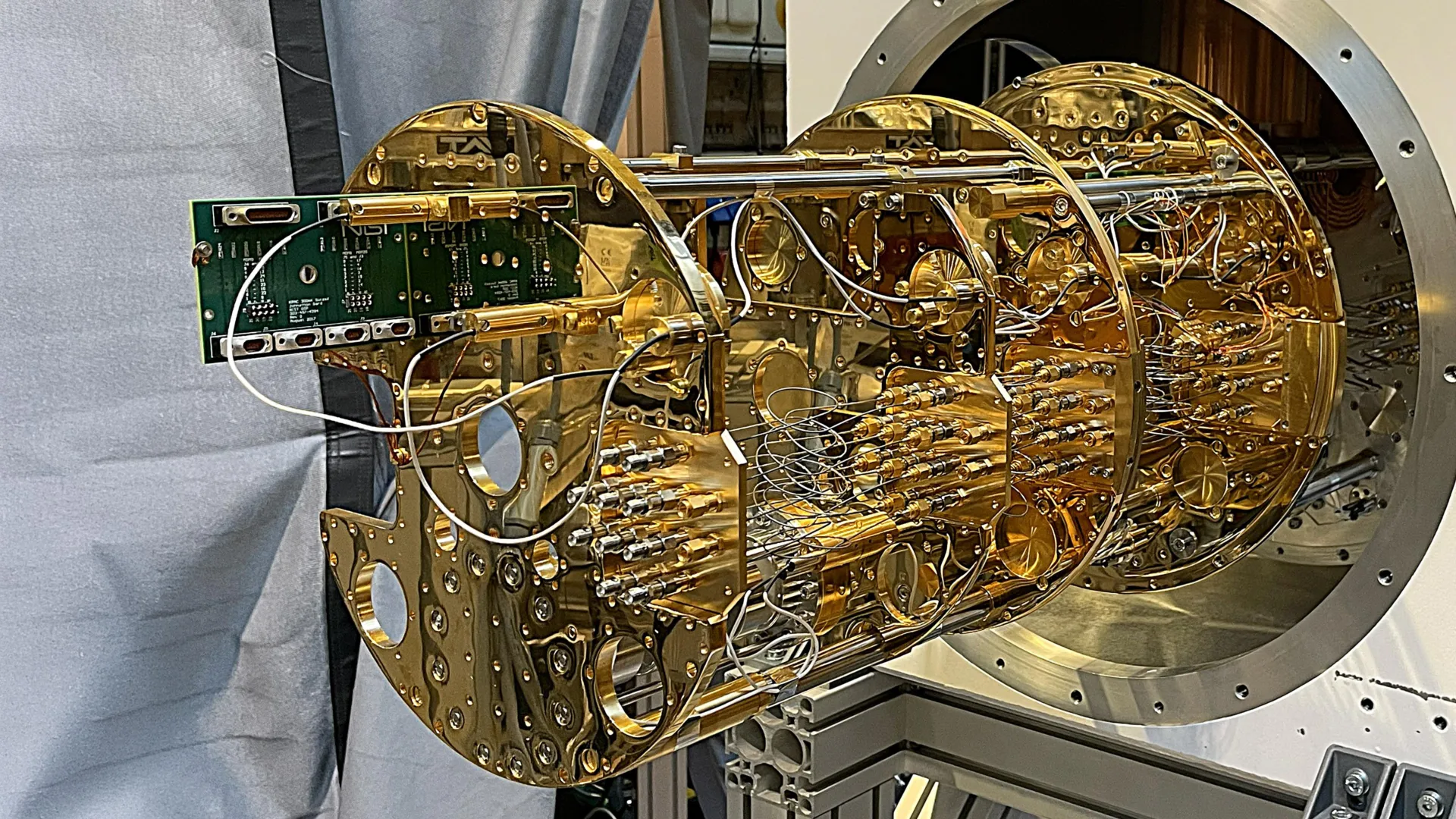
Researchers at BESSY II, a synchrotron facility in Berlin, have deployed a superconducting X-ray detector that achieves up to 1,000 times greater sensitivity than conventional systems. The device uses transition-edge sensor (TES) technology, marking Europe's first operational TES-based X-ray spectrometer at a synchrotron beamline.
The detector works by exploiting the sharp temperature transition that occurs when superconducting materials cross from their normal to superconducting state. X-ray photons strike tiny tungsten absorbers cooled to near absolute zero, causing minute temperature changes that correlate with photon energy. Sensitive thermometers measure these fluctuations, enabling precise energy resolution and detection of individual photons with exceptional efficiency.
This leap in sensitivity transforms what scientists can study. Researchers can now analyze atomically thin materials, nanostructures, and ultra-dilute samples at speeds previously impossible. Traditional X-ray detectors miss many photons, limiting analysis speed and forcing scientists to use higher radiation doses or work with larger samples. The TES system captures far more photons while consuming less beam time.
The breakthrough carries practical implications for materials science, chemistry, and nanotechnology. Scientists investigating two-dimensional materials, quantum dots, and trace elemental compositions can now gather data orders of magnitude faster. The reduced photon requirements also protect sensitive samples from radiation damage.
TES technology has existed in laboratory settings for years, but integrating it into a synchrotron beamline presents engineering challenges. The detector requires extreme cryogenic temperatures, sophisticated multiplexing to read hundreds of sensors simultaneously, and careful shielding from electromagnetic interference. BESSY II's deployment demonstrates that these hurdles can be overcome in a working facility accessible to the broader research community.
The advance positions Europe competitively in detector technology. Other synch