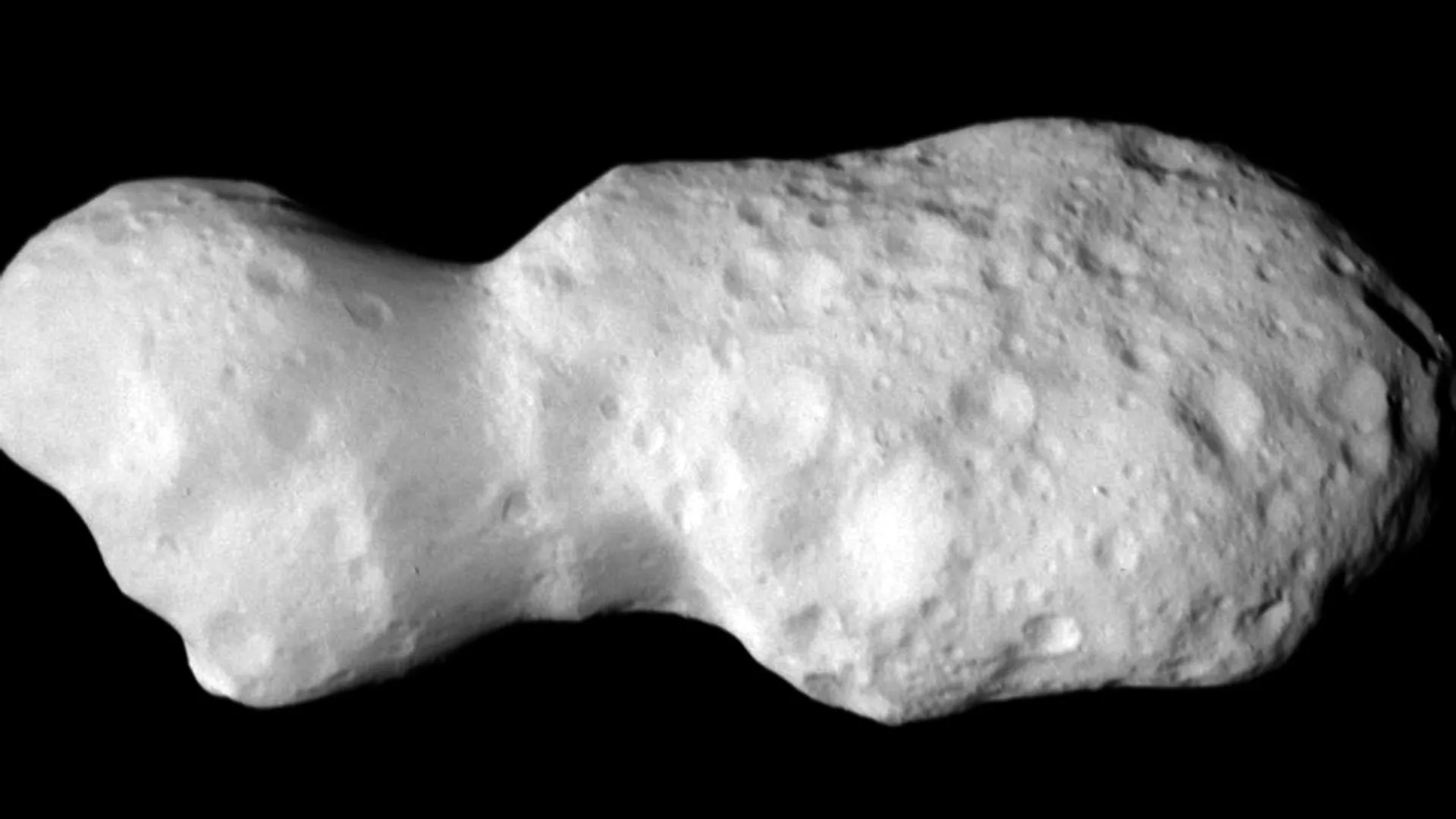
NASA's Lucy spacecraft has revealed that the asteroid Donaldjohanson exhibits an unusual wobbling motion and possesses a peanut-like binary shape, suggesting it formed from a catastrophic collision between two larger bodies. The discovery adds new detail to scientists' understanding of how asteroids in the solar system's early history were shaped and reshaped over billions of years.
The spacecraft detected evidence of hydrated minerals on Donaldjohanson's surface, indicating the presence of ancient water. This finding carries weight because water-bearing asteroids preserve chemical signatures from the solar system's formation period, roughly 4.6 billion years ago. Such materials may have delivered water and organic compounds to the early Earth.
The peanut shape itself reveals important physics. Donaldjohanson appears to be a contact binary, meaning two distinct bodies orbit so closely they nearly touch. The wobbling motion Lucy observed suggests the asteroid rotates in an unstable way, likely caused by its complex gravitational environment and the slow reshaping effect of solar radiation pressure, known as the Yarkovsky effect. This radiation pressure gradually alters an asteroid's orbit and shape over geological timescales.
Lucy, which launched in 2021, targets Jupiter's Trojan asteroids, ancient bodies sharing orbital paths with the giant planet. By studying these objects, researchers gain insight into planetary migration and the solar system's dynamical evolution. Donaldjohanson, encountered during Lucy's trajectory, has become an unexpected bonus discovery that validates the mission's scientific approach.
The detection of water-bearing minerals on a binary asteroid expands the catalog of how and where water exists throughout the solar system. It strengthens the hypothesis that volatile-rich bodies scattered throughout the asteroid belt during the young solar system's chaotic period, ultimately delivering life-essential ingredients to planets.
Lucy continues its mission toward the Trojan asteroids, with additional close approaches