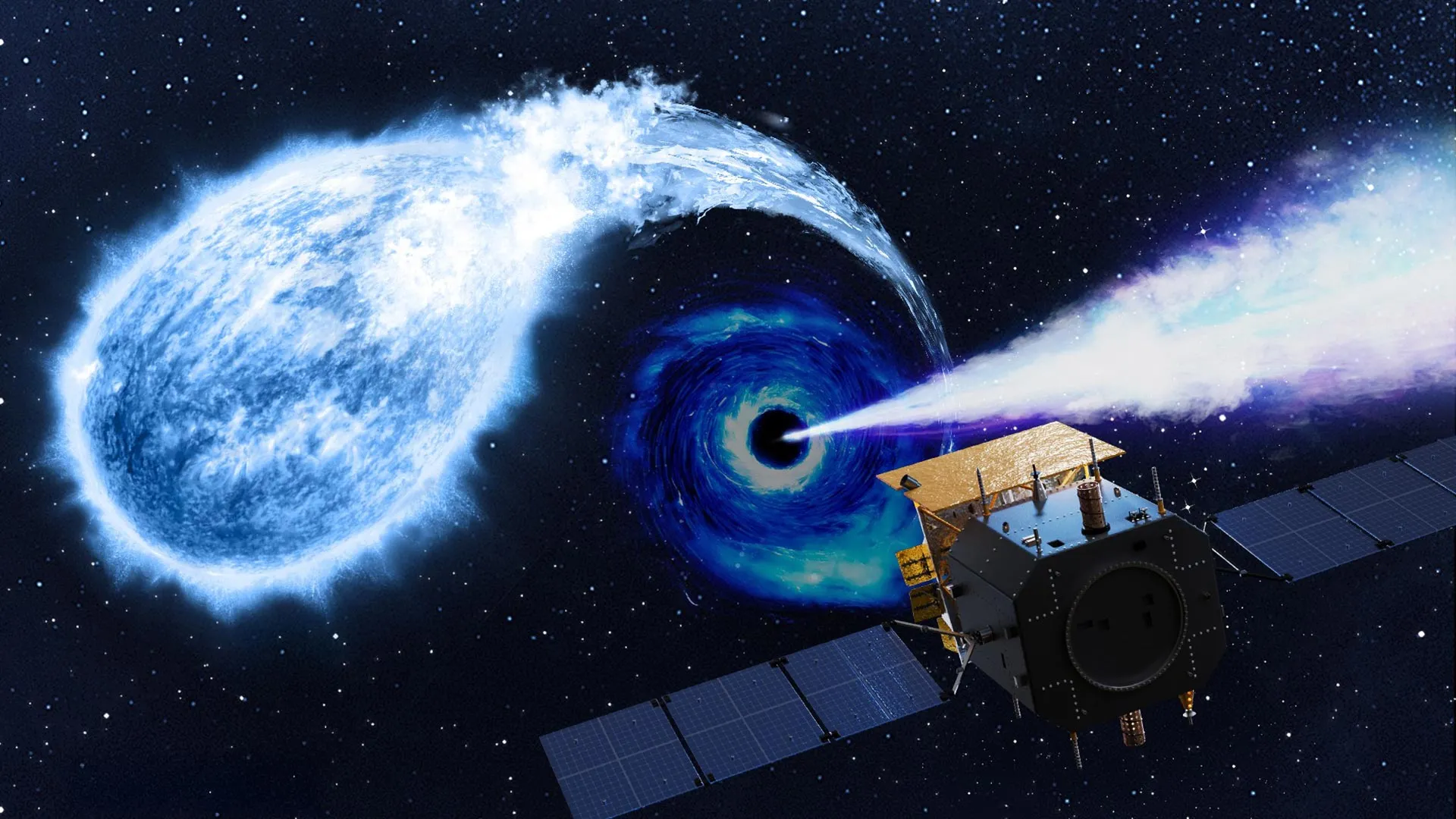
The Einstein Probe space telescope has likely captured the first observations of an intermediate-mass black hole shredding a white dwarf star, astronomers report. The event produced a distinctive sequence of intense X-ray flashes that differs fundamentally from standard gamma-ray bursts, according to the detection.
Intermediate-mass black holes occupy a mysterious middle ground in the cosmic hierarchy. Stellar-mass black holes form from collapsed stars and weigh a few times the sun's mass. Supermassive black holes anchor galaxies and reach billions of solar masses. Intermediate-mass black holes, ranging from hundreds to millions of solar masses, remain elusive and poorly understood.
When a black hole's gravity tears apart a nearby star, the process creates dramatic electromagnetic emissions. This "tidal disruption event" occurs when the black hole's gravitational pull stretches material from the star beyond survival. The stripped material heats to extreme temperatures and radiates intensely across the electromagnetic spectrum.
White dwarfs present an especially compelling target for this destruction. These are the exposed cores of dead stars, compressed to Earth-like size but retaining the mass of our sun. Their extreme density makes them rare fodder for tidal disruption compared to normal stars.
Einstein Probe, a Chinese space mission launched in 2024, observes the universe in soft X-rays and ultraviolet wavelengths. The telescope specializes in catching transient events in their earliest phases. This early detection proved crucial. The X-ray flashes showed an unusual temporal pattern diverging from typical gamma-ray bursts, which exhibit different energy release sequences.
The observation fills a critical gap in astrophysics. Tidal disruptions of white dwarfs by intermediate-mass black holes remain theoretically predicted but observationally rare. Confirming even one such event strengthens models describing black hole demographics and stellar destruction mechanisms.