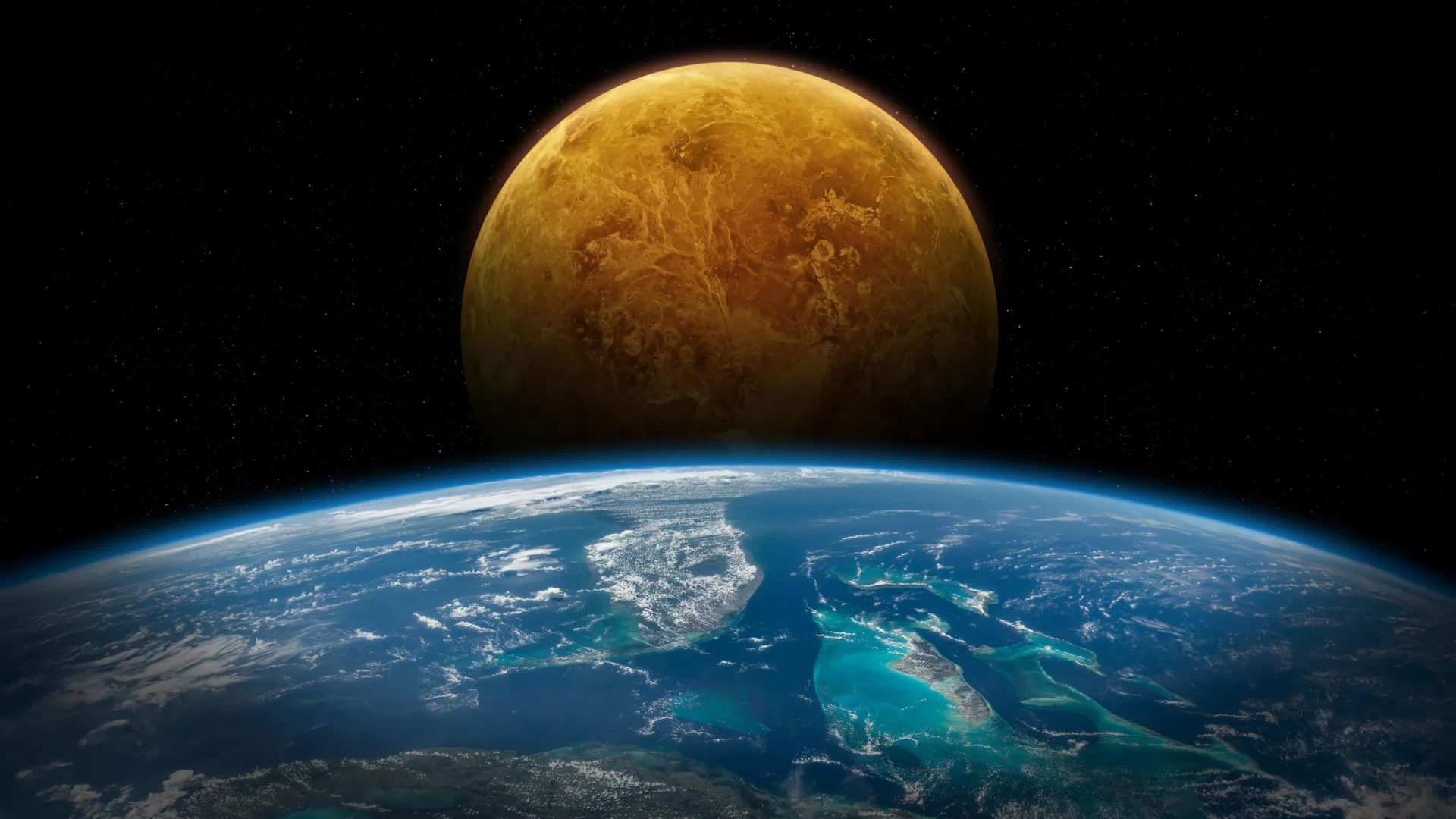
Asteroid impacts on Earth could have launched microbial life toward Venus billions of years ago, according to new research on panspermia between neighboring planets. The study proposes that violent collisions with asteroids possess sufficient energy to eject microorganisms into space, where some organisms might withstand radiation and vacuum conditions during transit between worlds.
Researchers examined whether microbes could survive the journey and establish themselves in Venus' upper atmosphere, where conditions are more hospitable than the planet's scorching surface. The clouds of Venus maintain temperatures and pressures similar to Earth's surface, creating pockets where certain extremophile organisms might persist.
The mechanism works through a process called lithopanspermia. When an asteroid strikes Earth with enough force, it can propel rocky debris containing dormant microbial spores beyond the planet's gravitational pull. Some researchers calculate that impacts large enough to produce extinction events generate velocities exceeding escape velocity, launching material toward neighboring planets.
Venus orbits close to Earth, making it a plausible destination for ejected material over geological timescales. The study notes that microbes protected within rock fragments could shield themselves from cosmic radiation during the journey, potentially taking months or years to reach Venus depending on orbital mechanics.
This research carries implications for astrobiology and the search for extraterrestrial life. If future Venus missions, such as those planned by space agencies exploring the planet's clouds, detect microorganisms, scientists cannot automatically assume Venusian origins. Life signatures could represent Earth's biological export rather than independent abiogenesis.
The hypothesis remains speculative. Scientists have not yet confirmed that microbes can survive the full transit between planets or that they could reproduce in Venus' atmosphere. Temperature fluctuations and chemical conditions in Venusian clouds present additional survival challenges beyond laboratory testing. Additionally, detecting whether Venus life shares genetic ancestry with Earth organisms would require sophisticated molecular analysis that current