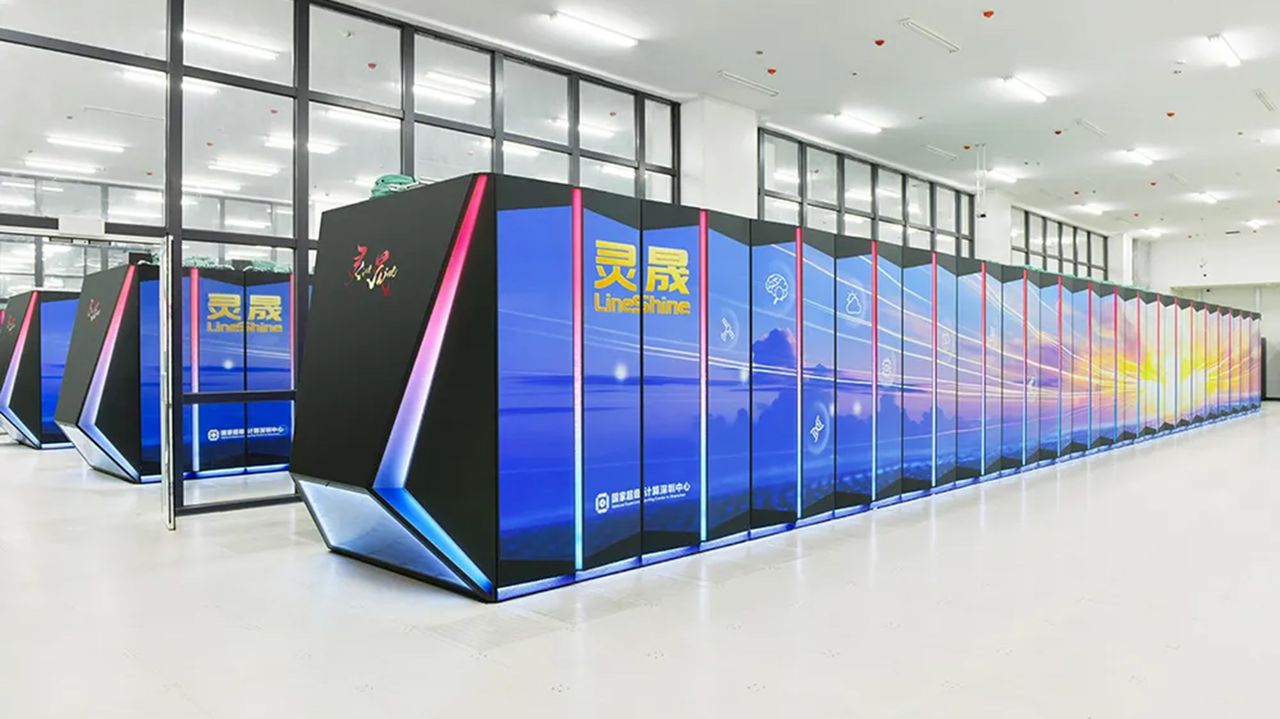
China's Linshui supercomputer has claimed the top position in global computing power rankings, marking the first Chinese machine to lead the world since 2017. The system surpasses all current United States supercomputers in raw computational performance.
The Linshui system represents a significant shift in supercomputing dominance. For years, American machines held the top rankings, with systems like Frontier at Oak Ridge National Laboratory leading global benchmarks. This transition reflects China's sustained investment in high-performance computing infrastructure and indigenous processor development.
Supercomputer rankings typically rely on the Linpack benchmark, which measures floating-point operations per second (FLOPS). The Linshui's ascendance indicates China has closed gaps in both hardware design and manufacturing capability. The country has progressively reduced reliance on Western semiconductor components, developing domestic processors for critical computing applications.
The geopolitical implications are substantial. Supercomputers drive scientific research across climate modeling, drug discovery, materials science, and artificial intelligence training. Computational supremacy translates to advantages in these domains. China's dominance in this arena enables faster development cycles for weather prediction systems, materials research, and autonomous systems.
However, rankings tell only part of the story. Speed alone does not determine a supercomputer's practical value. Energy efficiency, memory bandwidth, and specialized applications matter equally. Different workloads favor different architectures. A machine ranked first on Linpack may underperform on real-world scientific problems requiring specific optimization.
The United States still maintains numerous top-tier systems and retains advantages in many applications. Frontier and other American supercomputers excel at particular tasks despite no longer holding the absolute speed title. The competition between nations in computing power parallels broader technology competition spanning semiconductors, artificial intelligence, and quantum computing.
This development intensifies pressure on US policymakers to increase supercomputing investment and maintain technological leadership