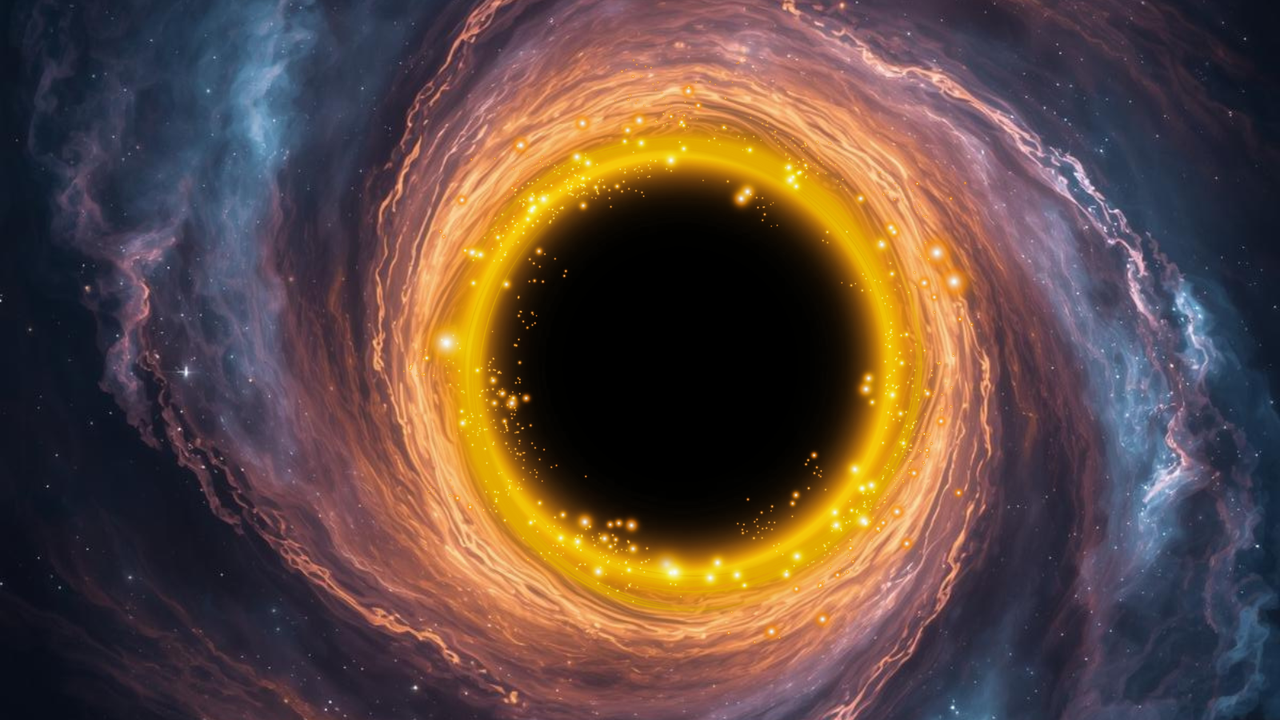
Astronomers have detected the loudest gravitational wave signal on record, created by two colliding black holes, offering a new window into the physics of event horizons. The extreme violence of this merger produced gravitational waves of unprecedented amplitude, researchers report.
Event horizons represent the point of no return around black holes. Once objects cross this boundary, not even light escapes. Direct observation of event horizons remains extraordinarily difficult, making indirect methods essential for understanding their properties.
The gravitational wave signal captures the final moments before the two black holes merged, when tidal forces reached their maximum strength. During this violent collision, the spacetime around the event horizons warped dramatically, rippling outward as detectable gravitational waves. The intensity of these waves scales with the violence of the merger, making the loudest signals particularly valuable for studying extreme physics.
Researchers analyzed the signal's characteristics to extract information about the event horizons involved. The frequency and amplitude of the gravitational waves encode details about the black holes' masses, spins, and orbital dynamics. By comparing observations against theoretical predictions, scientists can test whether black hole physics behaves as Einstein's general relativity predicts.
The detection comes from LIGO (Laser Interferometer Gravitational-Wave Observatory) and Virgo, the gravitational wave detector networks that have revolutionized black hole science since 2015. These facilities use laser interferometry to detect the tiny ripples in spacetime caused by distant cosmic events.
This loudest-ever signal provides a rare opportunity to study event horizon behavior in the strongest gravitational fields accessible to observation. The data constrains models of how black holes interact and merge, refining our understanding of spacetime's most extreme regions. Future detections of similarly powerful signals will allow scientists to build larger datasets and conduct more rigorous statistical tests of general relativity near event horizons.