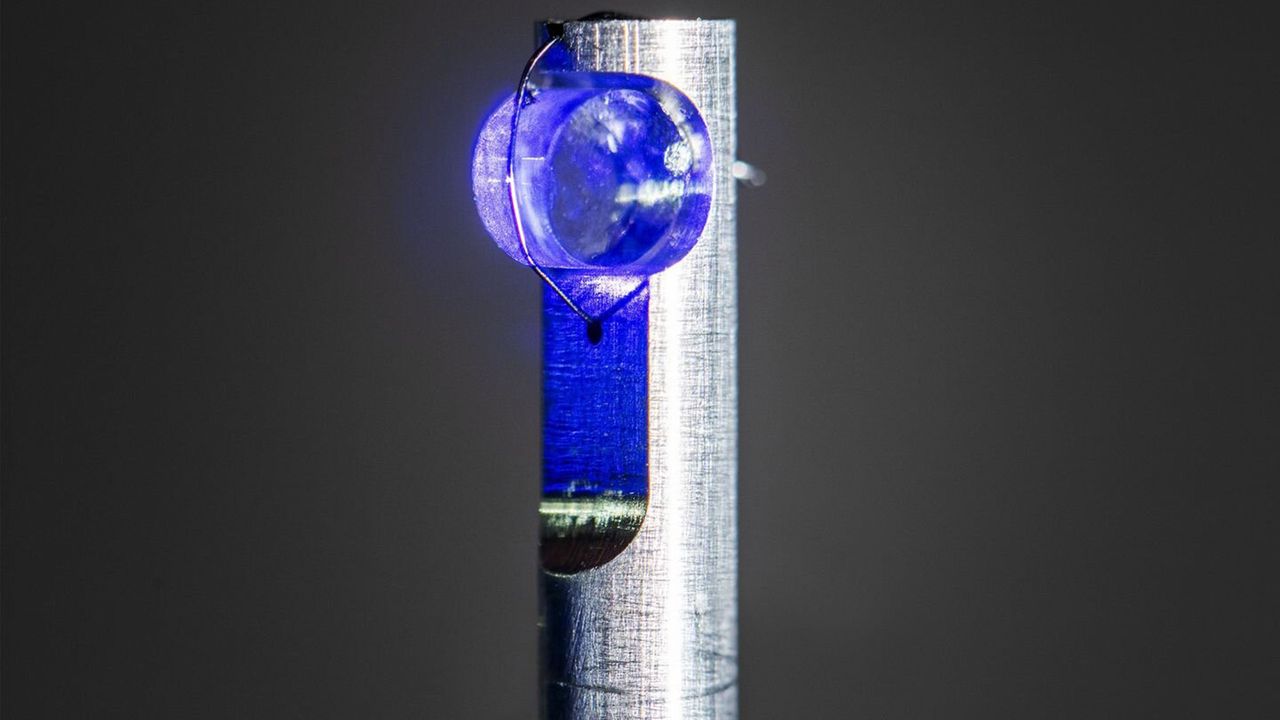
Physicists have constructed the world's first operational nuclear clock using a rare thorium nucleus as its timekeeping mechanism. This breakthrough represents a leap forward in precision measurement technology and opens new avenues for fundamental physics research.
The nuclear clock operates by tracking oscillations within a thorium nucleus, offering substantially greater precision than conventional atomic clocks that rely on electron transitions. Atomic clocks currently represent the most accurate timekeeping devices humanity has created, but nuclear clocks could surpass them by orders of magnitude.
The implications extend far beyond timekeeping. Researchers envision using nuclear clocks to hunt for dark matter and detect potential violations of fundamental physical constants. If these constants vary even slightly across space or time, an exceptionally precise nuclear clock could register the deviation. Such a discovery would point toward physics beyond the Standard Model.
The team demonstrated proof of concept by stabilizing the thorium nucleus's oscillations and maintaining frequency measurements over extended periods. This required isolating the nucleus from environmental interference and developing novel laser techniques to read its quantum state without disrupting it.
The research builds on decades of effort to develop nuclear clock prototypes. Earlier attempts struggled with technical challenges around exciting and monitoring nuclear transitions, but advances in laser technology and quantum control have made the achievement feasible.
Nuclear clocks could revolutionize tests of fundamental physics. A sufficiently precise clock could detect whether the fine-structure constant, which governs electromagnetic interactions, changes over time or location. Such variations would suggest new physics mechanisms currently unknown to science.
The technology also promises applications in quantum computing and fundamental metrology. More precise frequency standards enable better synchronization of distributed quantum systems and improved gravitational wave detection.
Current limitations include the complexity of the apparatus and the requirement for specialized isotopes. Scaling the technology and improving reliability remain ongoing challenges. Nevertheless, this demonstration validates the nuclear clock concept and justifies further development.
The work represents a convergence of quantum physics