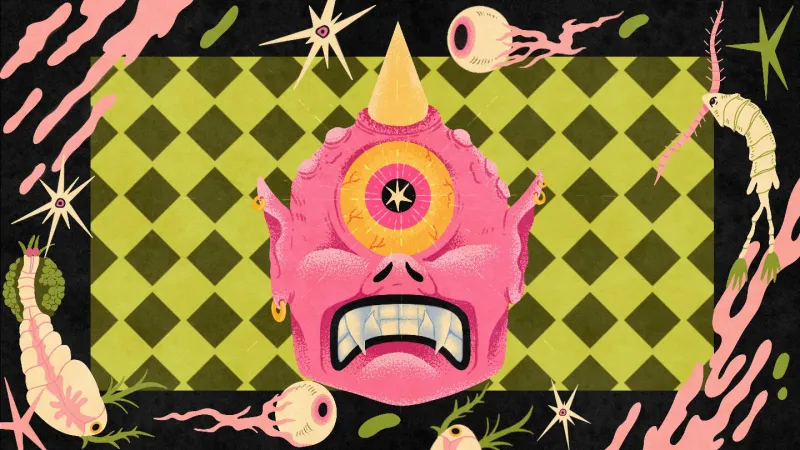
Researchers exploring the origins of Homer's Cyclops have discovered unexpected parallels between the mythological creature and microscopic organisms. The one-eyed giant may owe its existence to ancient Greeks' encounters with real biological specimens rather than pure imaginative invention.
Scientists examining the anatomy of the Cyclops myth point to copepods, tiny crustaceans that live in water and possess a single prominent eye. These organisms represent a plausible source of inspiration for the legendary monster. Ancient Greek sailors and naturalists, unfamiliar with deep-sea life, could have mistaken enlarged or unusual specimens for evidence of a larger creature.
The theory gains credibility when considering how ancient cultures explained unfamiliar animals. Greek naturalists documented numerous marine organisms, and exaggerated accounts of their appearance frequently entered popular mythology. The single eye of the copepod offers a concrete anatomical basis for the Cyclops legend, suggesting Homer drew from observed nature rather than pure fantasy.
This interpretation challenges the purely imaginative view of classical mythology. Instead, it positions ancient myths as filtered observations of the natural world, passed through layers of storytelling and misunderstanding. The Cyclops emerges not as a creature born entirely from imagination, but as a distorted reflection of real biology, magnified through cultural transmission.
The upcoming film adaptation brings renewed attention to these origin questions. While Hollywood's interpretation will undoubtedly prioritize spectacle over scientific accuracy, the scholarly debate reminds audiences that even ancient myths contain kernels of observable reality. The Cyclops and copepods represent an intersection where natural history and cultural legend collide, revealing how humans process and mythologize encounters with the unfamiliar world around them.