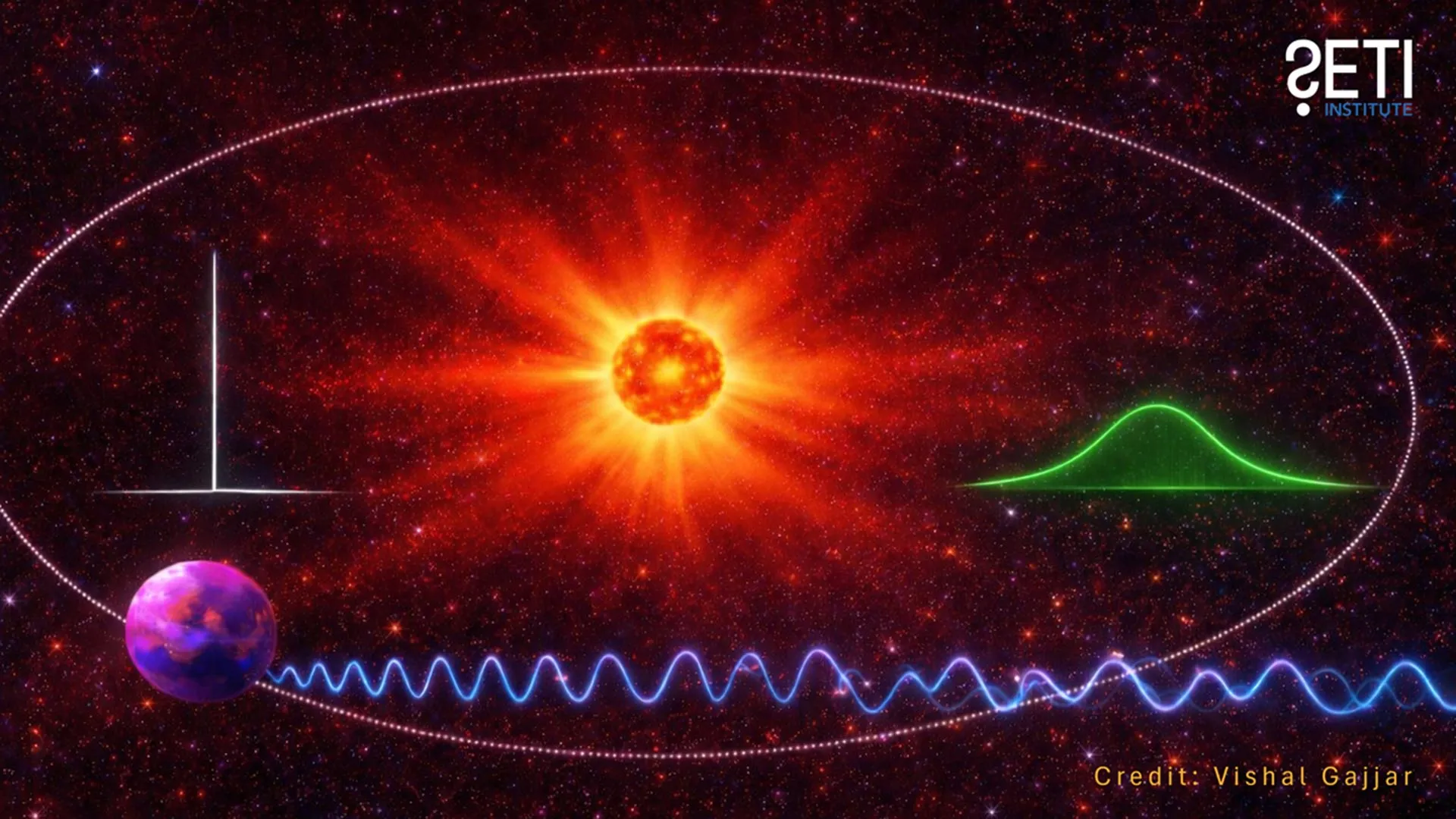
Researchers propose that Earth-based search for extraterrestrial intelligence efforts may be missing alien broadcasts because stellar interference scrambles signals before they leave other star systems. A new study from SETI researchers shows that turbulent plasma and powerful stellar storms can spread ultra-narrow radio transmissions across wider frequency ranges, degrading signal detectability using conventional search methods.
M-dwarf stars present the largest detection challenge. These red dwarfs represent the most abundant star type in the Milky Way, yet they produce intense magnetic activity and frequent stellar storms. When civilizations orbiting M-dwarfs transmit focused radio signals, the turbulent plasma surrounding their host star spreads those transmissions across broader frequencies, scattering the coherent signal that ground-based radio telescopes hunt for. Traditional SETI searches target narrow frequency bands where signals remain concentrated. Dispersed signals fall below detection thresholds or blend into background noise.
The finding reshapes assumptions about detection likelihood. Scientists have long considered M-dwarf systems promising targets for finding life because these stars vastly outnumber sun-like stars. However, the stellar environment around M-dwarfs may render their broadcasts nearly invisible to current search strategies. The effect operates independently of transmission power or civilization intent. Even advanced civilizations transmitting strong signals from M-dwarf systems would face this unavoidable physical barrier.
The study suggests SETI researchers should develop detection algorithms accounting for frequency dispersion caused by stellar plasma. Current searches typically filter out broadband signals as cosmic noise rather than analyzing them as potential alien communications modified by astrophysical processes. Adapting analysis methods to identify signatures of plasma-dispersed transmissions could reveal signals previously dismissed as interference.
This research carries both optimistic and cautionary implications. Optimistically, alien signals may already have reached Earth unrecognized. Cautiously, detecting life becomes substantially harder than earlier models suggested