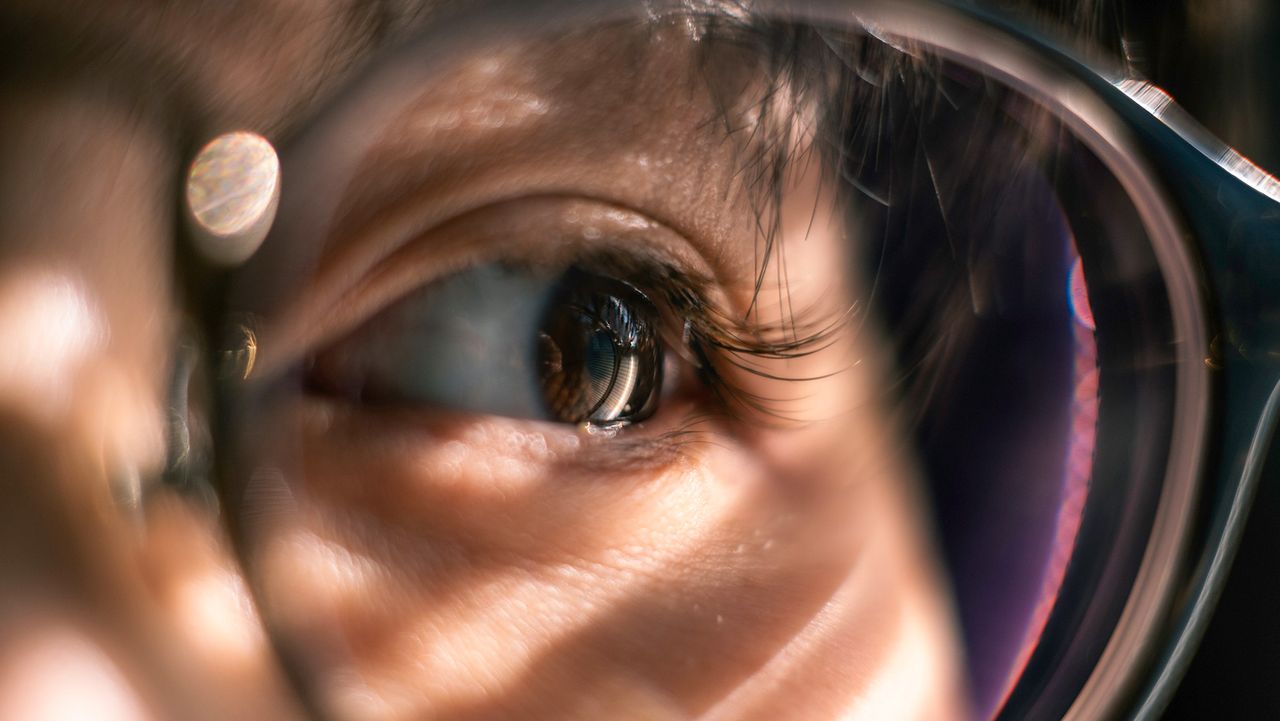
When you walk from bright sunlight into a darkened room, your vision doesn't instantly adapt. The process takes between 20 and 30 minutes for your eyes to reach peak sensitivity in low light, a phenomenon called dark adaptation.
The delay occurs because your eyes contain two types of light-sensitive cells: cones and rods. Cones dominate in daylight and provide color vision and sharp detail. Rods take over in darkness and detect even faint light, but they're far less sensitive when you first enter a dark space.
The biological mechanism behind this involves a molecule called rhodopsin. In bright conditions, light breaks down rhodopsin in your rod cells, rendering them temporarily useless. When you enter darkness, your eyes must regenerate rhodopsin from a precursor molecule called retinal and a protein called opsin. This biochemical process requires time. Your rod cells gradually accumulate fresh rhodopsin, progressively boosting their light sensitivity.
The regeneration happens in stages. Within the first five to ten minutes, your sensitivity increases dramatically as rods begin recovering. However, complete dark adaptation continues for another 20 to 25 minutes as more and more rods rebuild their rhodopsin stores. Your eyes reach maximum sensitivity only when nearly all available rhodopsin has been restored.
Evolution shaped this system because humans are diurnal creatures. Our ancestors relied primarily on daylight for survival. The rod-based system represents a tradeoff: rods provide exceptional sensitivity in darkness but require longer to activate compared to the instant response of cones in daylight.
Individual variations affect adaptation speed. Age matters significantly, with older adults requiring longer for full dark adaptation than younger people. Vitamin A deficiency impairs rhodopsin production, slowing the process. Red light exposure during bright conditions actually helps preserve some rod function, which is why astronomers and pilots use red lights in dark