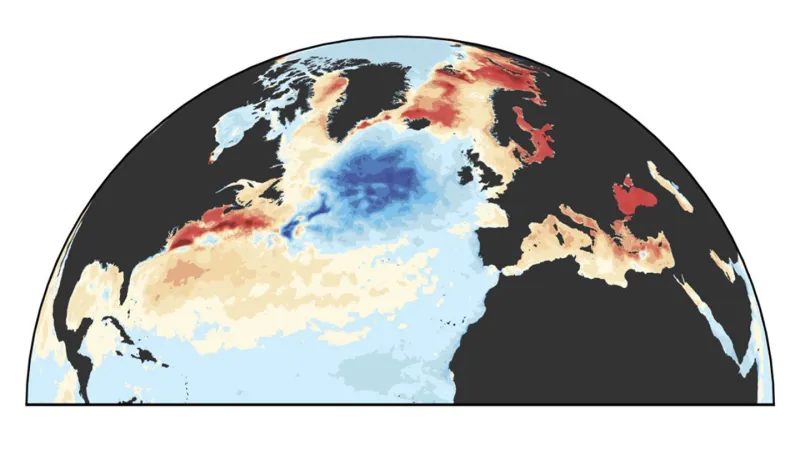
A persistent patch of unusually cold water in the North Atlantic may reflect a long-term decline in one of Earth's most powerful ocean currents, new research suggests.
Scientists have detected a "cold blob" in the subpolar North Atlantic that correlates with weakening in the Atlantic Meridional Overturning Circulation (AMOC), the system of currents that transports warm water northward and cold water southward. This circulation drives the Gulf Stream and regulates climate across the Northern Hemisphere.
The cold blob represents water that has not been warmed by the typical northward flow of tropical water. Its persistence signals that AMOC is delivering less heat to high latitudes than it historically has. Researchers attribute this weakening primarily to freshwater input from melting Arctic ice and Greenland's ice sheet, which reduces the density of surface waters and disrupts the sinking mechanism that drives the circulation.
AMOC operates through a process called thermohaline circulation. Cold, salty, dense water sinks in the North Atlantic, drawing warm surface water northward from the tropics. When freshwater from melting ice dilutes the surface layer, it becomes too buoyant to sink, breaking this cycle. Over the past century, AMOC has weakened by roughly 15 percent, according to prior studies.
The consequences extend globally. A significantly weakened AMOC could disrupt weather patterns, alter ocean nutrient distribution, and reduce heat transport to Europe. Some climate models suggest the current could weaken further or even collapse this century under continued climate change, though debate persists about the timeline and likelihood.
The cold blob itself serves as a visible indicator of deeper changes in ocean circulation. Its emergence validates predictions from climate models about how freshwater input would reshape Atlantic dynamics. However, researchers caution that short-term fluctuations can complicate interpretation. Distinguishing long-term