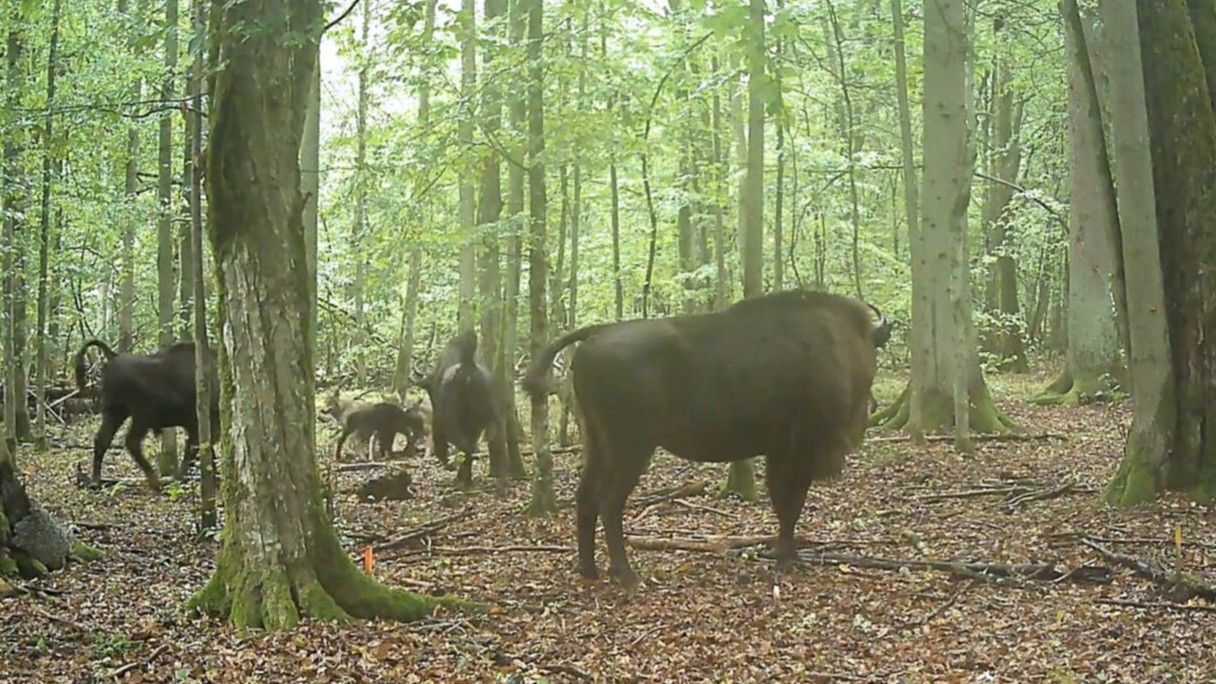
Researchers documenting wildlife in Poland's Bialowieza Primeval Forest have recorded the first documented wolf attack on European bison, capturing footage that reveals new details about predator-prey dynamics in one of Europe's last intact forests.
The video shows wolves targeting a newborn calf while the adult bison herd defends the young animal, providing scientists with rare insight into how these large herbivores respond to predation pressure. European bison, also called wisent, weigh up to 900 kilograms and represent one of Europe's largest land mammals. Wolves were reintroduced to Bialowieza, a UNESCO World Heritage site straddling the Poland-Belarus border, after being hunted to extinction in the region.
The footage documents predator-prey interactions in a landscape largely shaped by natural processes rather than human management. Bialowieza spans roughly 1,500 square kilometers and hosts populations of wolves, lynx, and ungulates including deer, wild boar, and bison. The first-of-its-kind recording of this specific interaction adds to understanding of how apex predators influence ecosystem structure and herbivore behavior.
The herd's coordinated defense of the calf suggests bison employ group protection strategies when facing wolf packs. This behavior has ecological implications, potentially affecting how wolves select prey and how bison populations structure themselves. Researchers note that such observations remain rare because documenting predation events requires sustained fieldwork in remote forest habitats.
The significance extends beyond simple predator-prey documentation. Reintroduced wolf populations across Europe have sparked ongoing debates about large carnivore management, livestock protection, and coexistence with humans. Data from natural predation events help inform these discussions with evidence-based understanding rather than speculation.
Bialowieza serves as a natural laboratory for studying ecosystem recovery. The forest was heavily logged during