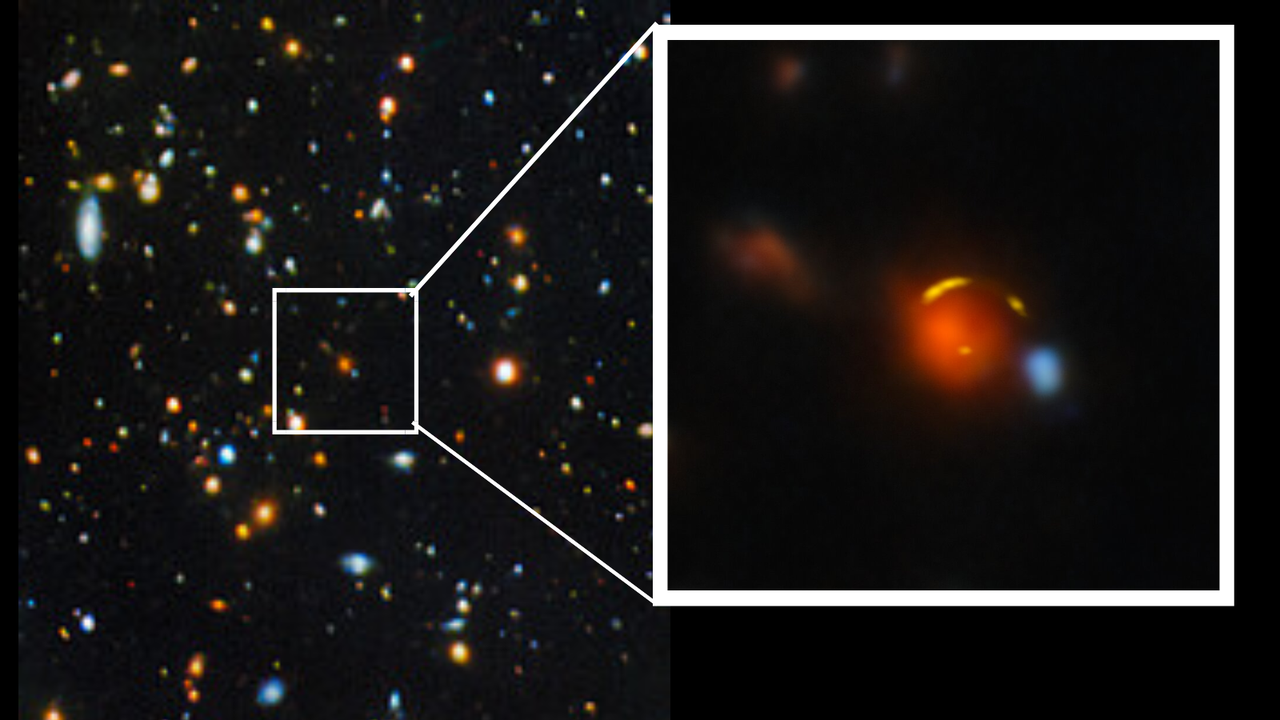
Researchers have identified a potential source of a high-energy neutrino that struck Earth, tracing it back to a distant dusty star-forming galaxy nicknamed "Shadow Blaster." If confirmed, this discovery marks the first time scientists have directly connected an individual dusty star-forming galaxy to a detected neutrino event.
Neutrinos are subatomic particles produced by nuclear reactions in stars, supernovae, and other cosmic events. They travel nearly unimpeded through space and matter, making them extraordinarily difficult to detect. High-energy neutrinos originate from violent cosmic phenomena and carry information about events occurring in the most extreme environments in the universe.
The detection represents a significant advance in neutrino astronomy. Previous identifications of neutrino sources relied primarily on blazars and active galactic nuclei, supermassive black holes at galaxy centers that launch jets of material outward at nearly light speed. Dusty star-forming galaxies operate under different physical mechanisms and emit radiation differently, so linking one to a neutrino detection opens new territory for understanding cosmic particle acceleration.
The research leveraged observations from multiple telescopes and detectors. The high-energy neutrino itself was likely captured by IceCube, the neutrino observatory buried beneath Antarctic ice. Astronomers then conducted follow-up observations using infrared and radio telescopes to identify potential sources. The multi-wavelength approach allowed researchers to narrow down the neutrino's origin point to Shadow Blaster.
Dusty star-forming galaxies represent a class of objects that undergo intense stellar birth but shroud themselves in dust, making them difficult to observe in visible light. Their vigorous star formation and powerful stellar winds create conditions potentially capable of accelerating particles to the extreme energies needed to produce high-energy neutrinos.
The confirmation hinges on additional observations and statistical analysis. Scientists must rule out the