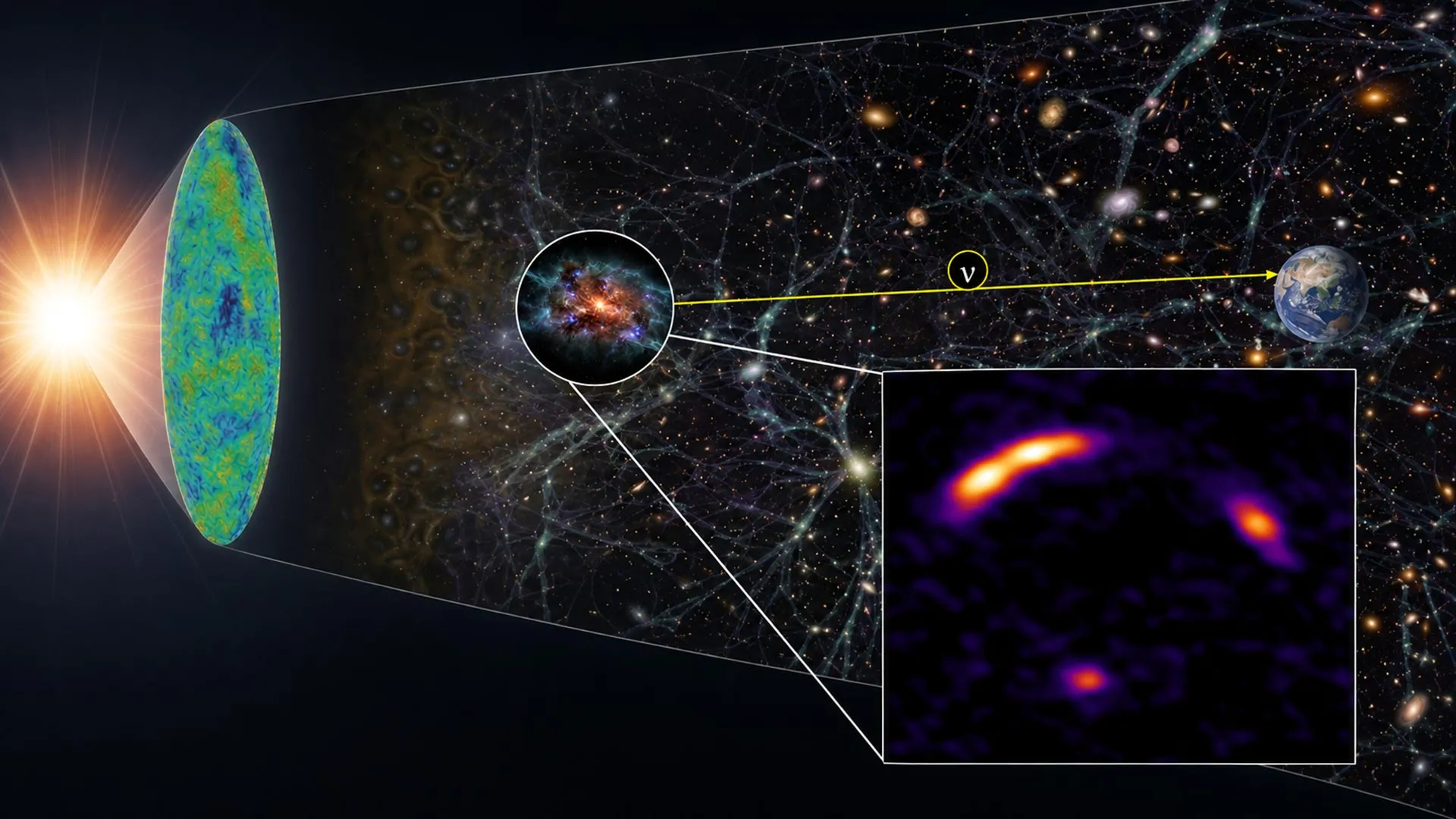
Astronomers hunting for supermassive black holes in distant galaxies stumbled upon something unexpected. The Shadow Blaster galaxy, observed through infrared and radio telescopes, showed signs of extreme neutrino emission. Researchers initially suspected a feeding black hole as the source. Instead, they found an intensely active region of star formation.
This discovery, published findings suggest, challenges assumptions about where high-energy cosmic neutrinos originate. Neutrinos stream constantly from space, yet their sources remain largely mysterious. Black holes rank among leading candidates. The Shadow Blaster observation indicates that starburst galaxies, shrouded in dust and difficult to detect optically, may contribute substantially to this cosmic neutrino flux.
The galaxy's activity level proves extreme. Stars form at rates vastly exceeding our Milky Way. Within such violent environments, massive stars explode as supernovae, accelerating cosmic rays. These energetic particles collide with surrounding gas and dust, producing neutrinos. The radio and infrared data revealed this starburst signature more clearly than initial observations suggested.
The research opens a new avenue for neutrino astronomy. If hidden starburst galaxies populate the distant Universe in significant numbers, they could account for a considerable share of high-energy neutrinos detected by instruments like IceCube, the massive neutrino detector buried beneath Antarctic ice. This would reshape models of neutrino production across cosmic time.
However, limitations accompany this finding. A single galaxy observation cannot establish a universal pattern. Researchers must examine additional starburst systems to confirm whether Shadow Blaster represents a common phenomenon or an outlier. The dust obscuring these galaxies from optical telescopes complicates follow-up studies.
The discovery also matters for understanding galaxy evolution. Starburst episodes reveal how galaxies transform violently during their lifetimes. Tracing