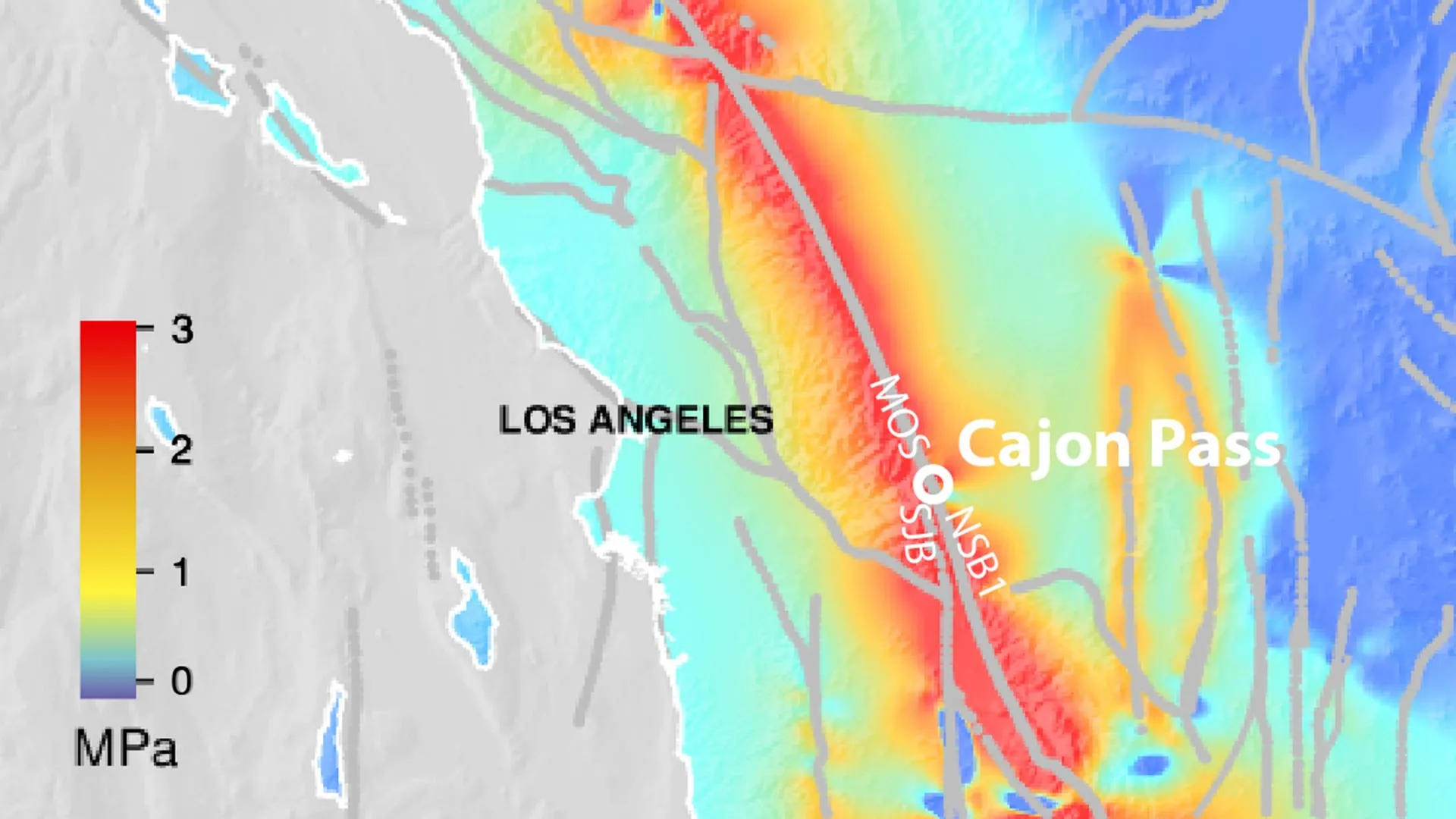
Scientists have discovered that Southern California's fault system faces unprecedented stress levels, with conditions now matching those preceding the region's largest historical earthquakes over the past millennium.
A new study reveals that the San Andreas and San Jacinto faults currently experience more stress than at any point in the last 1,000 years. Researchers identified a critical zone at Cajon Pass, where these two major faults intersect, that functions as an "earthquake gate." This gateway structure determines whether a future rupture will remain confined to one fault or propagate across both systems, potentially triggering a much larger seismic event.
The research team analyzed the stress distribution along both faults and found that current conditions closely resemble the geological state before some of Southern California's most destructive historical earthquakes. This parallel suggests elevated risk for a major seismic event in the coming decades.
The Cajon Pass acts as a stress bottleneck. When stress builds on one fault, it creates pressure at this intersection point. Whether accumulated stress releases through one fault or cascades across both depends on the precise stress geometry and fault properties at this location. If rupture breaches the gate, the consequences could be catastrophic. A simultaneous rupture along both the San Andreas and San Jacinto faults would far exceed the magnitude of events affecting either fault independently.
The study builds on decades of seismic monitoring and paleoseismic records showing past earthquake patterns. Researchers used sophisticated modeling to reconstruct stress conditions over centuries and project current trends. The work underscores how fault systems operate as interconnected networks rather than isolated rupture zones.
Limitations exist in earthquake prediction. Knowing stress levels does not provide timing information. California's faults could accumulate stress for decades or centuries before rupture occurs. Additionally, unexpected factors like fluid pressure changes or triggered stress transfer from distant earthquakes could alter rupture behavior unpredictably.