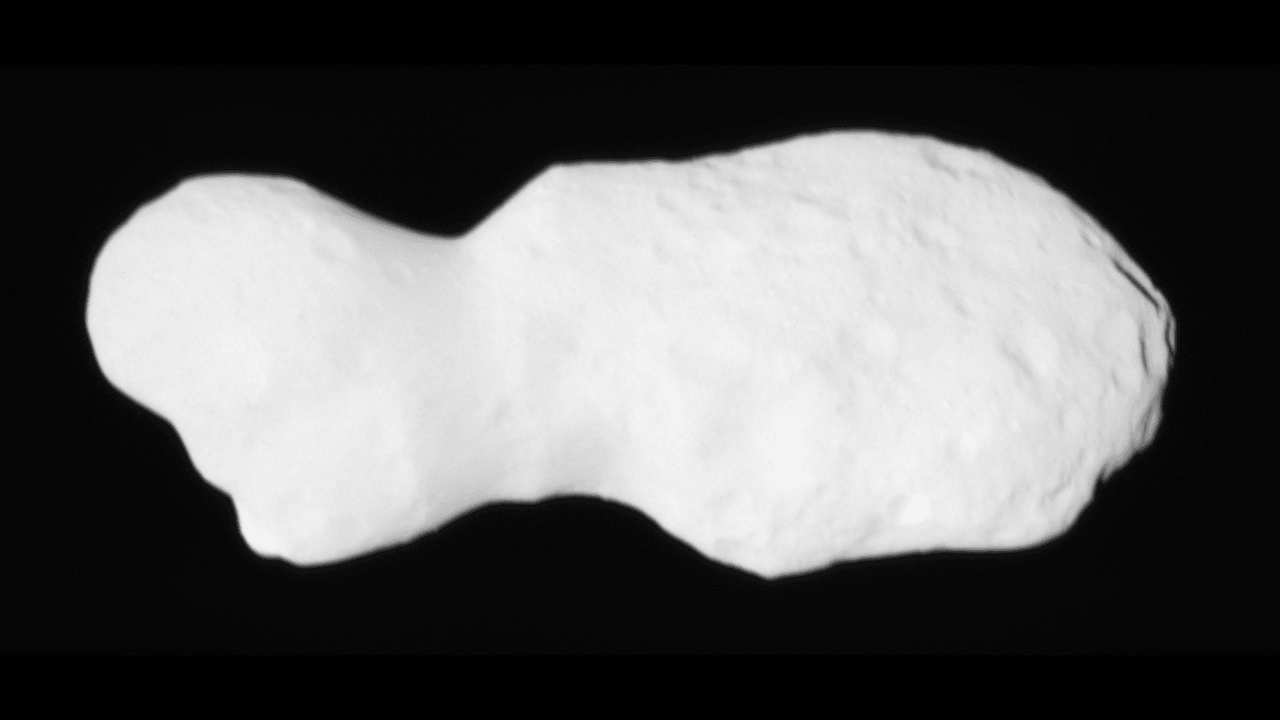
NASA's Lucy spacecraft has provided fresh evidence that the asteroid Donaldjohanson underwent chemical transformation from liquid water interactions. The discovery suggests the space rock originally formed in a cooler region of the early solar system before migrating inward toward the sun.
Lucy, which launched in 2021 on a twelve-year mission to study Jupiter's Trojan asteroids, conducted a flyby of Donaldjohanson in November 2023. Spectroscopic data collected during that encounter revealed mineral compositions consistent with aqueous alteration, the process by which water chemically modifies rock over time.
The findings indicate Donaldjohanson formed in a region where temperatures were low enough for liquid water to exist and interact with the asteroid's surface materials. Researchers believe gravitational interactions with other solar system bodies later shifted the asteroid into its current orbital location closer to the sun, a phenomenon called dynamical migration that planetary scientists understand shaped the early solar system's architecture.
This discovery adds to mounting evidence that water and aqueous processes were widespread throughout the early solar system, not confined to Earth or the inner planets. The presence of water-altered minerals on Donaldjohanson suggests similar chemical processes likely occurred across numerous small bodies in the primordial solar system.
The data also helps constrain models of solar system formation and migration. By studying objects like Donaldjohanson that preserve evidence of their original formation locations, researchers can better understand the distribution of water-bearing materials and potentially trace the sources of water that may have delivered life-sustaining compounds to early Earth.
Lucy continues its mission and will encounter additional asteroids in coming years, with encounters planned through 2033. Each flyby provides researchers with comparative data on asteroid compositions, formation histories, and early solar system conditions.