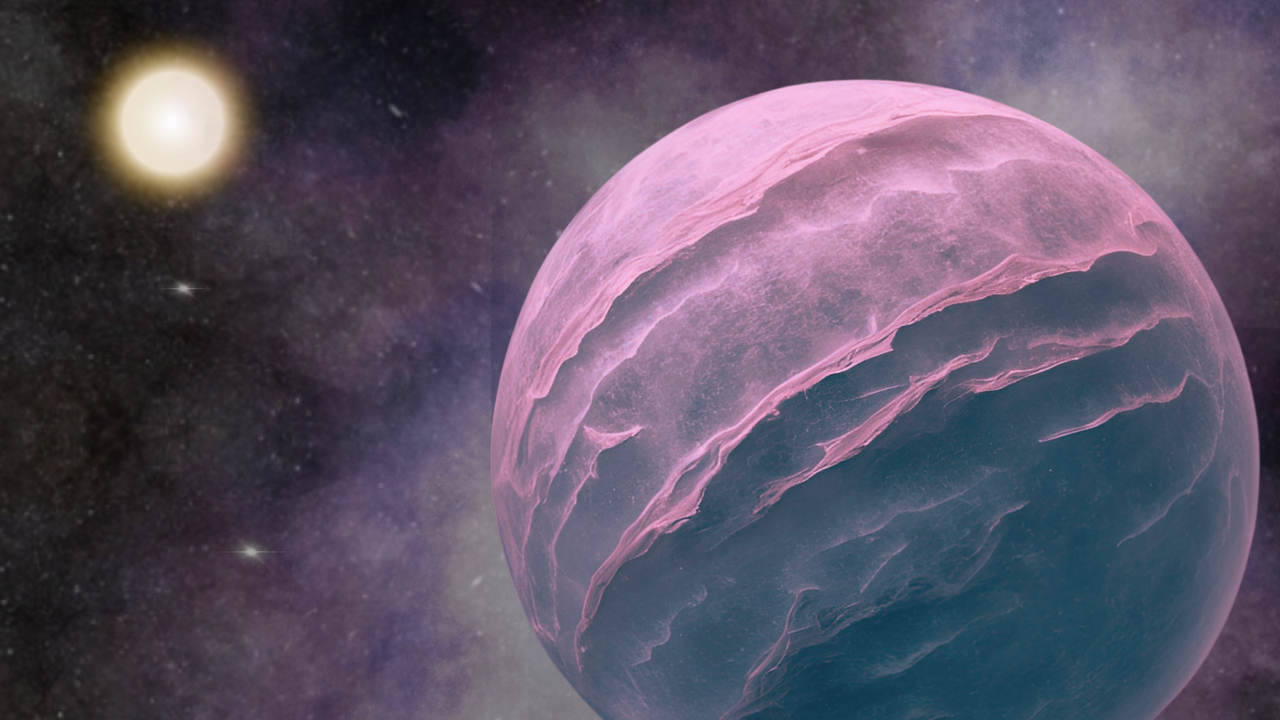
The James Webb Space Telescope has detected salt in the atmosphere of K2-18b, an exoplanet roughly 124 light-years away that earned the nickname "Pink Planet" for its distinctive hue. Researchers identified sodium chloride in the atmosphere of this super-Neptune, a cold world with a surface temperature estimated below minus 100 degrees Celsius.
The discovery came through spectroscopic analysis of light passing through K2-18b's atmosphere as the planet transits its host star. The salt detection adds to previous findings about this world's composition, including the presence of methane and carbon dioxide. The layered atmospheric data helps astronomers build a more complete picture of how this distant world differs from planets in Earth's solar system.
K2-18b orbits in the habitable zone of its star, meaning it sits at a distance where liquid water could theoretically exist on a surface. However, the planet's actual conditions remain harsh. Its mass suggests a thick, hydrogen-rich atmosphere and extreme pressure, making traditional habitability unlikely. The salt presence raises questions about the planet's formation history and whether it once had more water or underwent significant chemical changes.
Astronomers studying K2-18b use it as a test case for understanding super-Neptunes, a category of exoplanets common in other star systems but absent from our own cosmic neighborhood. By analyzing the atmospheric composition of such worlds, researchers refine their models for planetary formation and evolution. Each chemical signature detected helps constrain theories about how planets develop and what conditions shape their atmospheres over time.
The James Webb Space Telescope's infrared capabilities enable detection of subtle atmospheric features impossible to observe with previous instruments. This salt discovery demonstrates how the observatory continues revealing surprises about distant worlds and expanding the inventory of exoplanet characteristics. Future observations of K2-18b and similar planets will likely yield more compositional details, further