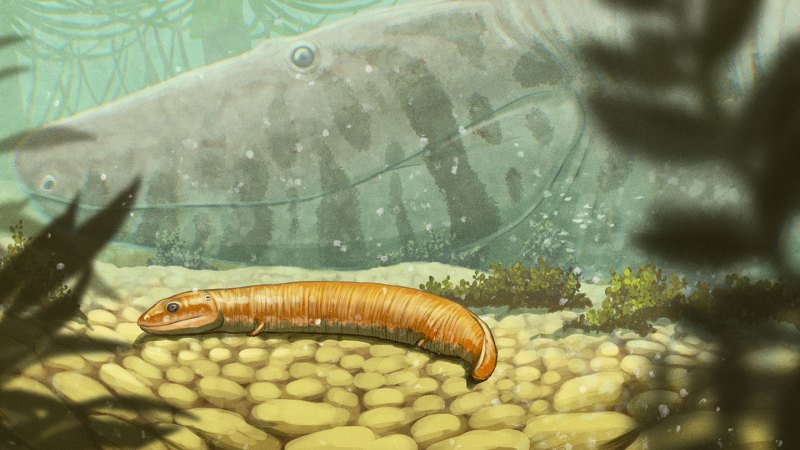
Researchers have identified three vertebrate species from 308 million years ago that challenge a foundational assumption in evolutionary biology. The discovery questions whether early land vertebrates underwent amphibian-like metamorphosis, a process long considered essential to the vertebrate transition from water to land.
The three species, which lived during the Carboniferous period, show anatomical features inconsistent with metamorphosis. Textbooks have typically presented metamorphosis as a key adaptation enabling early vertebrates to colonize terrestrial environments. The process would have allowed juveniles to develop in water before transforming into land-adapted adults.
These newly examined fossils present a different scenario. Their skeletal morphology indicates they likely did not experience dramatic physiological reorganization during development. Instead, the evidence suggests these early vertebrates may have exhibited more gradual developmental patterns or direct development from juvenile to adult form.
The research calls into question how scientists conceptualize the vertebrate invasion of land. For decades, the metamorphosis model provided a neat explanation for how creatures could exploit both aquatic and terrestrial niches sequentially during their lifespans. Removing this requirement forces reconsideration of what adaptations actually enabled the first vertebrates to survive on land.
The findings do not eliminate metamorphosis entirely from early vertebrate evolution. Rather, they suggest the process may have evolved later than previously thought or remained less widespread among early land colonizers than assumed.
This discovery underscores how fossil evidence can overturn long-held textbook assumptions. Paleontologists continue to refine understanding of vertebrate origins through careful anatomical analysis of preserved specimens. The three Carboniferous species serve as important data points in reconstructing the complex evolutionary pathway from aquatic ancestors to diverse terrestrial lineages.
Future research will likely focus on examining additional specimens from this period to determine how common non-metamorphic development was among early land vertebrates