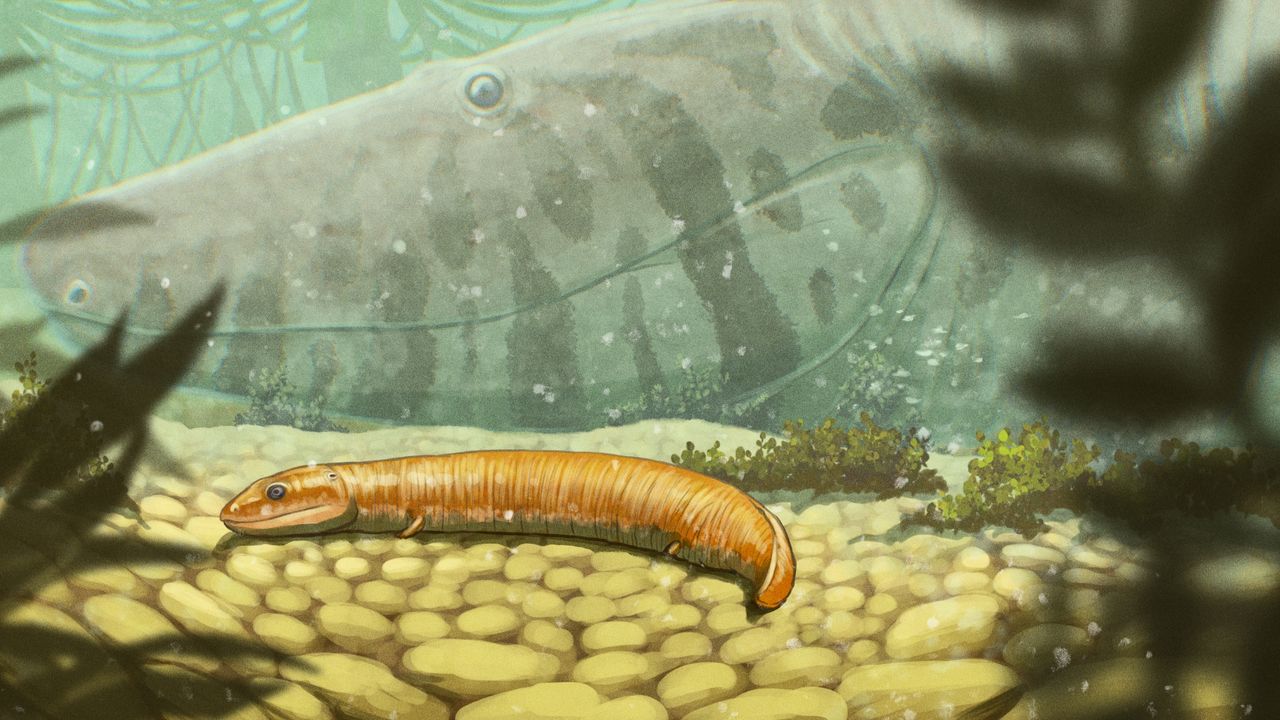
Researchers analyzing rare fossils discovered near Chicago have overturned assumptions about how the first four-legged vertebrates conquered land. The 300-million-year-old specimens reveal that early tetrapods did not follow the amphibian-like life cycle scientists long believed.
The traditional model held that the first land-dwelling vertebrates reproduced in water and passed through larval stages before maturing on land, similar to modern frogs and salamanders. The newly studied fossils challenge this narrative entirely.
Scientists examined skeletal features and growth patterns in the specimens, which preserve evidence of direct development from embryo to juvenile without an aquatic larval phase. This represents a fundamental shift in how these creatures reproduced and developed.
The fossil evidence suggests that early tetrapods achieved reproductive independence from water far earlier than previously thought. They likely laid eggs on land and produced offspring capable of surviving terrestrial environments immediately, without requiring a return to aquatic habitats for development.
This discovery reshapes our understanding of the vertebrate transition from water to land, one of biology's most significant evolutionary shifts. The researchers note that direct development would have allowed these creatures to colonize terrestrial environments more efficiently and reduce their dependence on freshwater systems.
The Chicago fossils represent an exceptional window into early tetrapod biology. Most specimens from this period are too fragmentary or poorly preserved to reveal such detailed developmental information. The quality and completeness of these remains enabled researchers to distinguish growth rings and identify skeletal markers indicating developmental stage at death.
These findings have implications for understanding vertebrate evolution broadly. The ability to reproduce entirely on land would have provided crucial selective advantages during the Carboniferous Period, when swamps and coastal environments dominated much of North America.
The study appears in a peer-reviewed journal and builds on decades of paleontological work examining the land colonization of tetrapods. While amphibian-style reproduction remains common