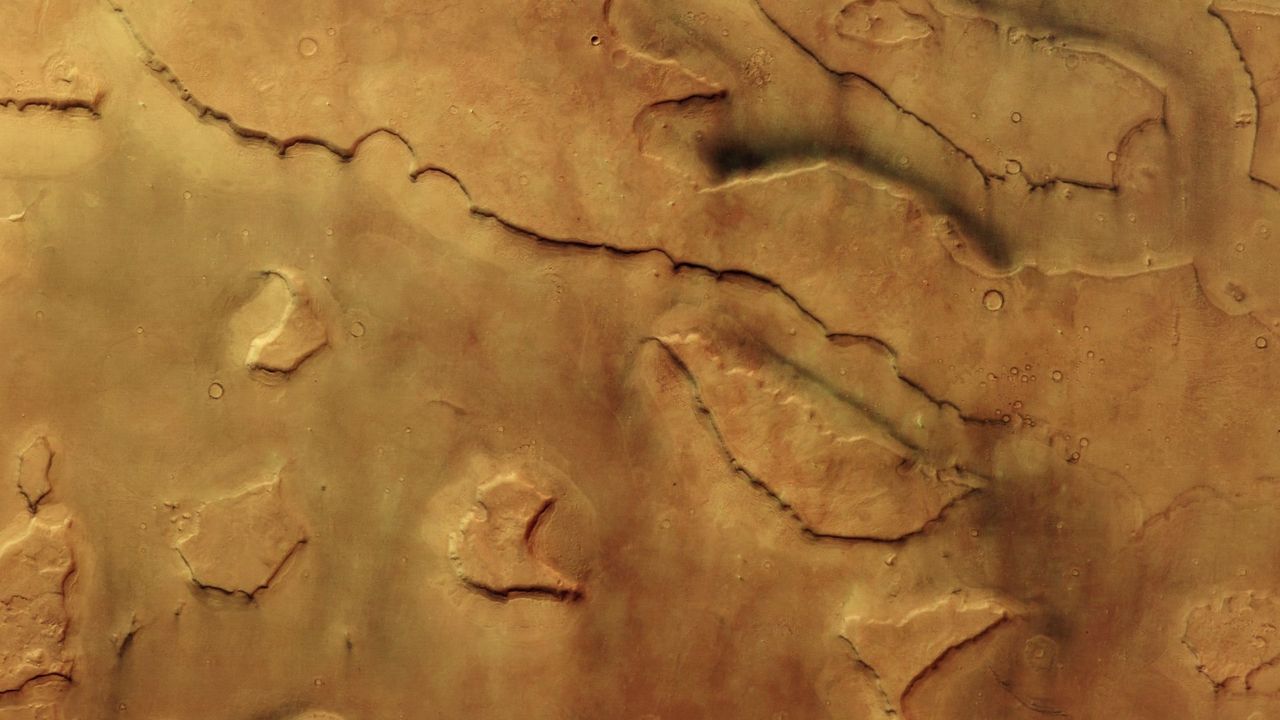
Europe's Mars Express orbiter captured images of a massive valley system on Mars containing approximately 30 dust devils swirling across the Martian surface. The dust devils, which are rotating columns of warm air and dust, appear scattered throughout the valley landscape in the recent photographs.
Dust devils on Mars form through similar mechanisms to those on Earth, where solar heating creates temperature differences in the atmosphere near the ground. The resulting convection causes air to spin, lifting dust particles into visible columns that can tower thousands of meters high. On Mars, these phenomena occur more frequently in certain regions during specific seasons when atmospheric conditions favor their development.
The Mars Express orbiter, operated by the European Space Agency, has been studying the Red Planet since 2003. Its high-resolution imaging systems regularly document atmospheric phenomena and surface features that help scientists understand Martian geology and climate patterns. Dust devils represent important markers of atmospheric dynamics on Mars.
Observing multiple dust devils in a single location provides researchers with data about local wind patterns and heating effects in that region. The valley system's topography likely concentrates wind flows and creates ideal conditions for dust devil formation. Such observations contribute to broader understanding of Mars' thin atmosphere and how it interacts with surface features.
The discovery illustrates how orbital imaging continues to reveal the dynamic nature of Mars. While the planet appears static in many views, its atmosphere remains active with phenomena like dust devils, dust storms, and seasonal wind patterns. Future Mars missions will benefit from these baseline observations as scientists work to predict atmospheric behavior and plan surface operations for robotic rovers and eventual human exploration.