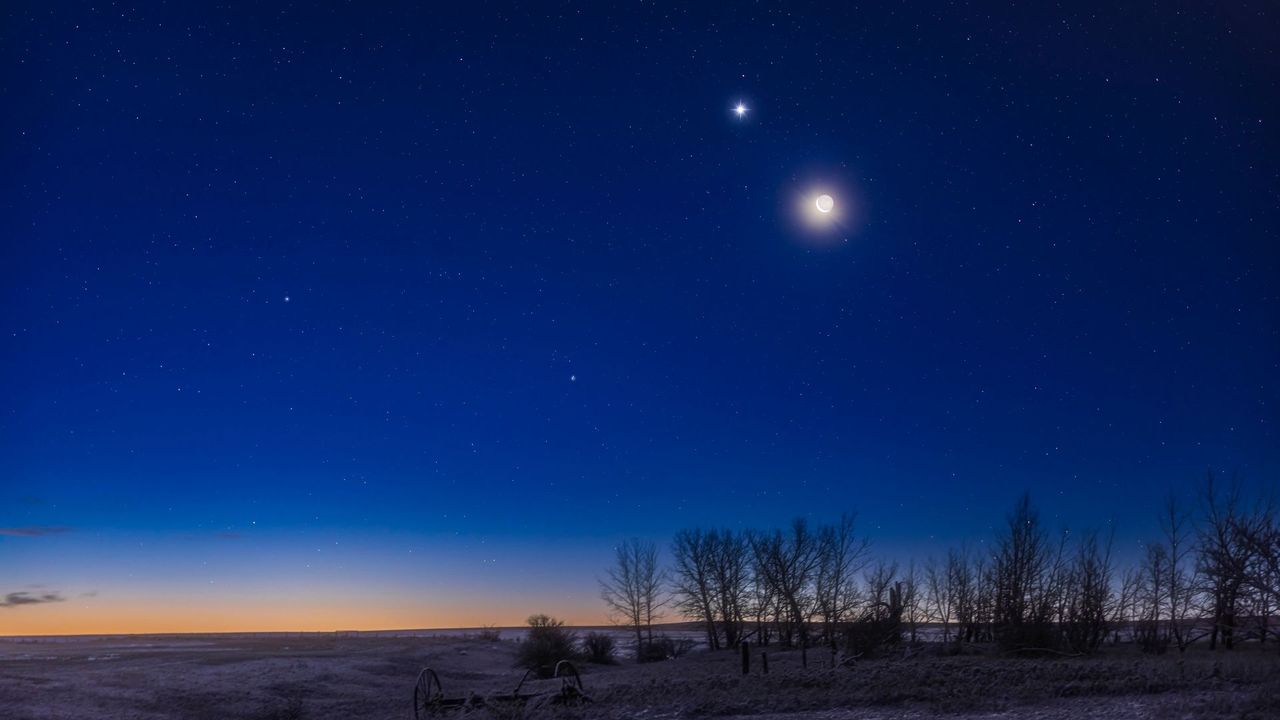
A crescent moon will join three naked-eye planets in Earth's evening sky on June 17, creating a rare celestial alignment visible to observers without telescopes.
The thin crescent will appear near Jupiter, Venus, and Mercury as it passes through the Beehive open star cluster, also known as Messier 44. The cluster sits roughly 600 light-years away in the constellation Cancer and contains hundreds of young stars bound together by gravity.
Alignments of this type occur when celestial objects line up from Earth's perspective, though they remain at vastly different distances in space. The crescent phase occurs when the moon sits between Earth and the sun, with only its edge illuminated. During this alignment, observers will need to look toward the western horizon shortly after sunset for the best viewing.
Jupiter and Venus rank among the brightest objects in the night sky and typically dominate evening viewing. Mercury, smaller and closer to the sun, appears dimmer but remains visible to the naked eye under dark skies. The Beehive cluster, despite containing hundreds of stars, appears as a faint fuzzy patch without optical aid, though binoculars reveal its stellar population clearly.
Such conjunctions have captured human attention for millennia. Ancient astronomers used planetary alignments to mark calendar dates and predict seasonal changes. Modern observers treat these events as opportunities to step outside and witness the geometry of the solar system.
Clear skies and low light pollution improve visibility. Observers in urban areas may struggle to see Mercury or the Beehive cluster due to atmospheric haze and artificial light. Those with binoculars or small telescopes can observe individual stars within the cluster and potentially spot fainter background stars.
The specific arrangement of planets and moon reflects the orbital mechanics of objects moving at different speeds around the sun. Venus orbits faster than Earth, causing it to appear to move relative to background stars. The