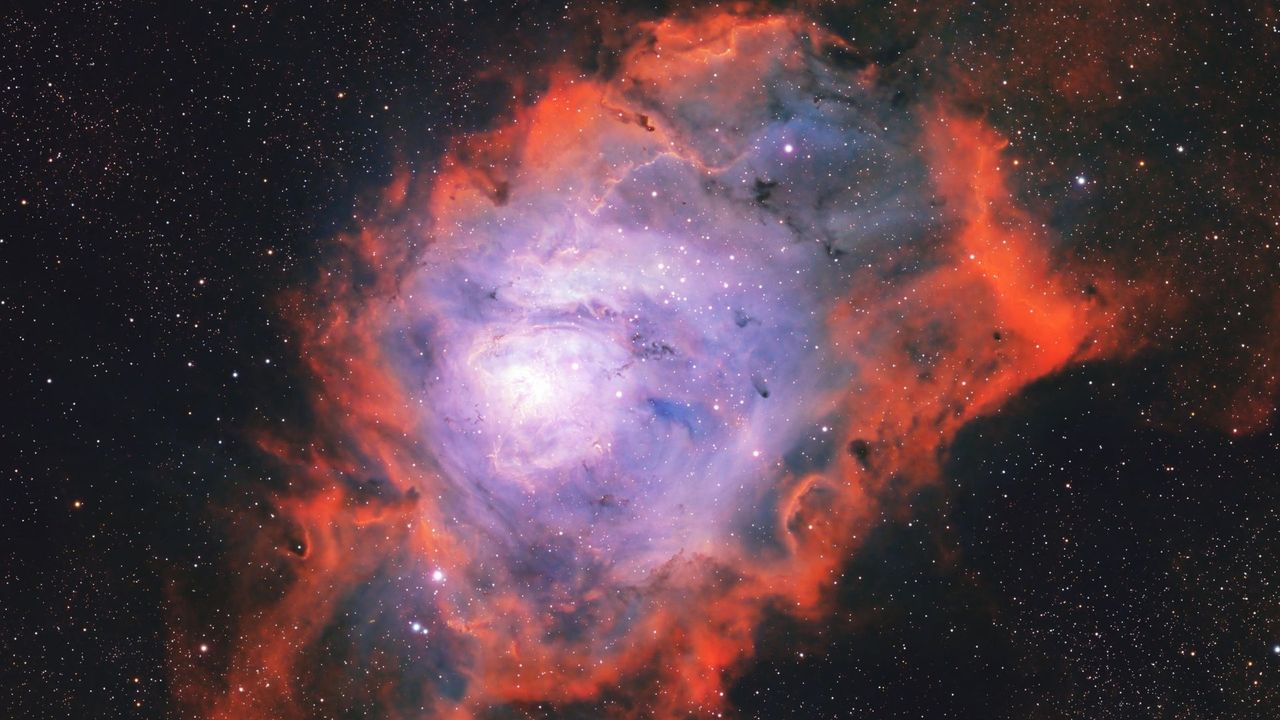
Astrophotographer captures stunning image of the Lagoon Nebula, a vast cloud of gas and dust located 5,200 light-years from Earth. The nebula glows brilliantly in the southern constellation Sagittarius, becoming most visible during Northern Hemisphere summer months around August.
The Lagoon Nebula, formally cataloged as Messier 8, spans roughly 55 light-years across and contains active regions of stellar formation. Its distinctive reddish glow comes from hydrogen gas ionized by intense radiation from young, hot stars embedded within the cloud. The nebula's characteristic lagoon appearance, which inspired its common name, results from dark dust lanes cutting through luminous gas regions, creating striking contrasts in the visible light spectrum.
Amateur astrophotographers can observe the Lagoon Nebula using telescopes or binoculars, though detailed imaging requires longer exposures and specialized equipment. The nebula appears as a faint, nebulous patch to the naked eye under dark skies, but photographs reveal its full splendor. Professional observatories and space telescopes have captured increasingly detailed images revealing the complex structure of star-forming regions within the nebula.
The Lagoon Nebula serves as a valuable research target for astronomers studying stellar birth processes. The intense star formation occurring within the cloud generates powerful stellar winds and radiation that shape the surrounding gas. Understanding these dynamics helps scientists comprehend how massive stars form and influence their natal environments.
For Northern Hemisphere observers, late July through September offers optimal viewing conditions when Sagittarius reaches higher positions in the southern sky. The nebula's visibility improves significantly in locations with minimal light pollution. Southern Hemisphere observers enjoy better positioning for viewing the Lagoon Nebula throughout the year.
Recent astrophotography captures showcase the nebula's intricate details, from dense dust structures to bright