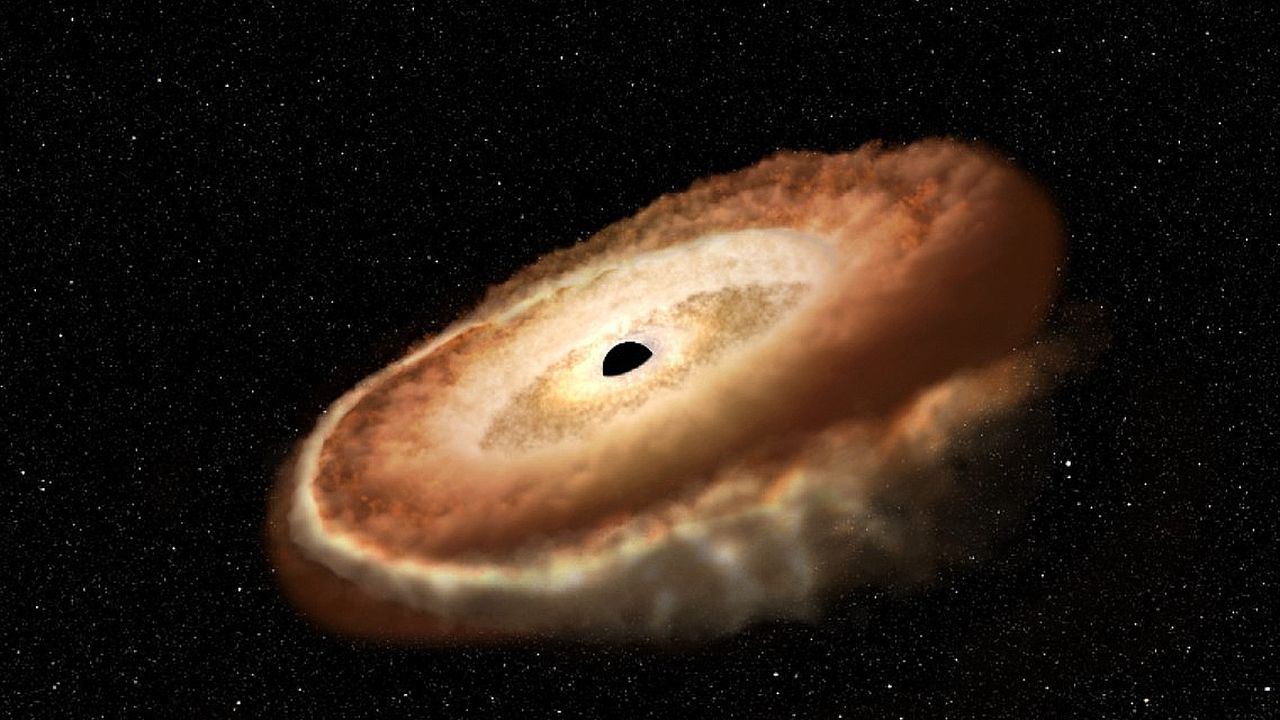
Astronomers have identified why black holes emit powerful radio bursts years after consuming stars, a discovery that allows researchers to predict these cosmic events before they occur.
The delay between a black hole's meal and its radio "burp" has long puzzled astrophysicists. New research explains the mechanism behind this temporal gap. When a black hole consumes stellar material, it doesn't immediately release all the energy outward. Instead, the consumed material undergoes complex chemical and physical transformations within the accretion disk surrounding the black hole.
The study reveals that these transformations take years to complete. During this period, material spirals inward while being heated to extreme temperatures. Chemical composition changes occur as elements are ionized and reorganized. Only after sufficient energy accumulates and specific conditions align does the black hole release a powerful outward jet of radiation and particles, producing the distinctive radio bursts astronomers detect.
This discovery provides a chemical blueprint that researchers can use to identify which black holes are likely to produce radio bursts in the near future. By analyzing the composition of material around a black hole and measuring current energy levels, astronomers can now predict these events with greater accuracy than previously possible.
The findings advance our understanding of black hole physics and their interaction with surrounding material. Radio bursts from black holes serve as cosmic laboratories for studying extreme physics conditions that cannot be replicated on Earth. Predicting these events allows astronomers to coordinate observations across multiple telescopes and instruments, maximizing scientific data collection during these brief, powerful phenomena.
This work represents a step forward in transitioning black hole observation from purely reactive astronomy, where researchers study events after they occur, to predictive astronomy, where phenomena can be anticipated and observed systematically. Future observations using this predictive framework will refine the chemical models and potentially reveal new insights about black hole feeding mechanisms and relativistic jet formation.