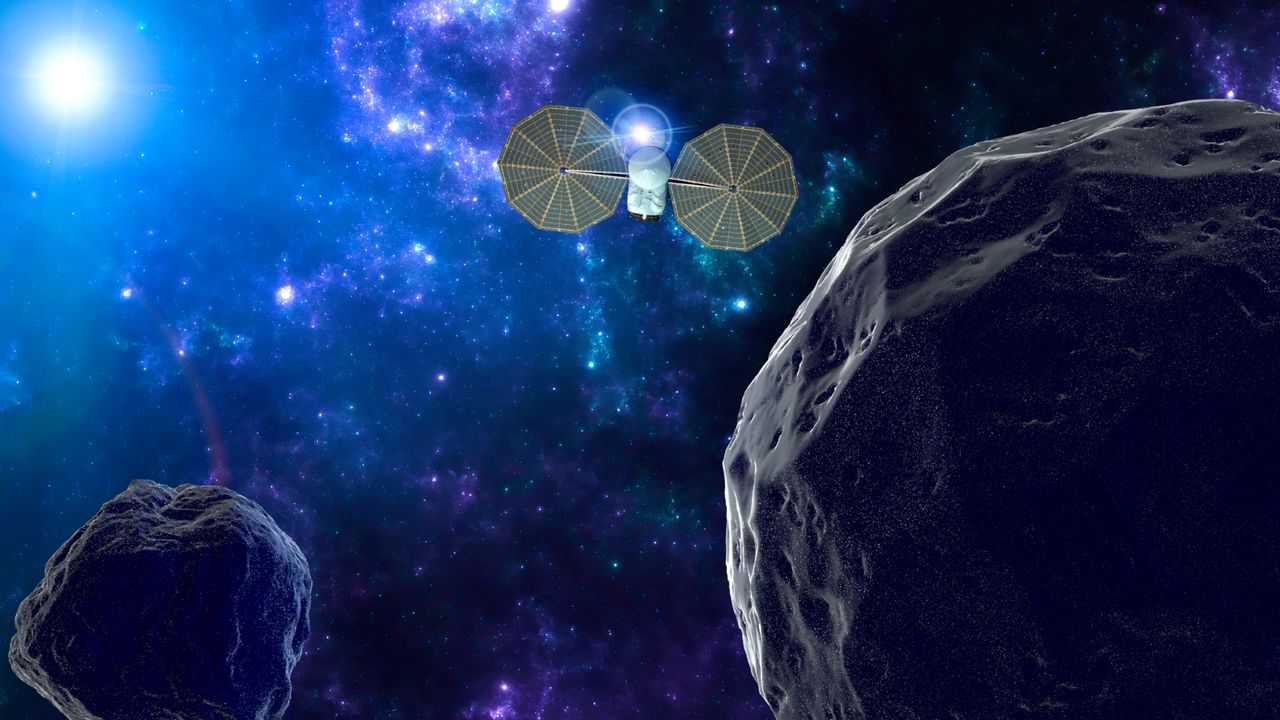
China's Tianwen-2 spacecraft has reached Kamo'oalewa, an asteroid that orbits the sun in lockstep with Earth, making it a quasi-moon. The mission will attempt to collect samples from this mysterious object, marking the first landing attempt on this particular type of celestial body.
Kamo'oalewa orbits roughly 40 million kilometers from Earth and stays in proximity to our planet due to orbital resonance. Unlike traditional moons that orbit planets, quasi-moons follow independent solar orbits that happen to keep them near their companion world. The Hawaiian name Kamo'oalewa means "the object that darts about," fitting for an asteroid discovered in 2016 by astronomers using the Pan-STARRS telescope.
The probe will scoop up regolith samples from the asteroid's surface, which scientists believe may reveal clues about its origin. Researchers suspect Kamo'oalewa could be a fragment of Earth's moon, ejected by an ancient impact, or material from the asteroid belt captured into Earth's orbital neighborhood. The samples will help answer these questions when returned to laboratories.
The landing operation represents a technical achievement in several respects. Kamo'oalewa measures only 40 to 60 meters across, making it an extremely small target for precision landing. The asteroid's weak gravity requires specialized descent procedures that differ from landings on larger bodies. Communication delays and the object's distance from Earth add operational complexity.
China has not publicly disclosed extensive details about Tianwen-2's timeline or methods, which explains the "secretive" characterization. The mission follows China's successful Chang'e lunar program and builds on its demonstrated capability to execute complex deep-space operations. A successful sample return would position China alongside NASA and JAXA as nations capable of bringing extraterrestrial material back to Earth.
The