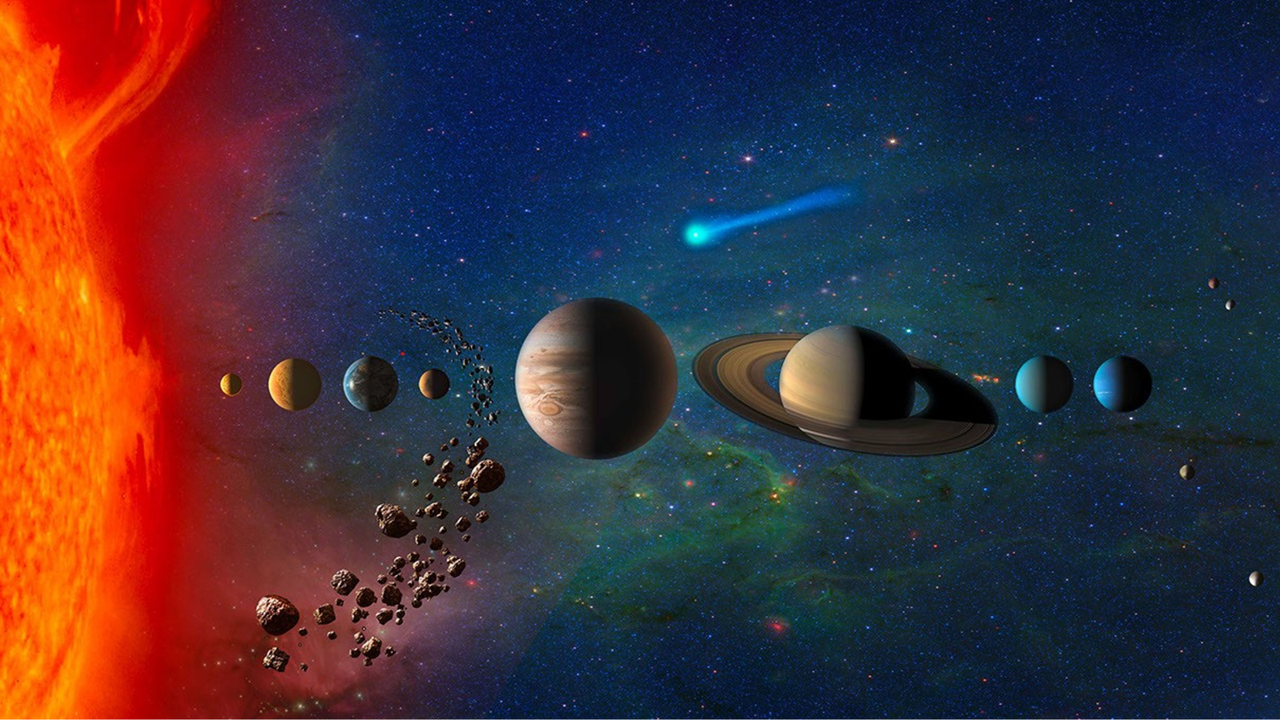
Researchers propose that Jupiter played a crucial role in delivering life's chemical building blocks to early Earth through asteroid delivery systems. The giant planet's gravitational influence may have shepherded asteroids containing organic compounds and water from the inner solar system toward Earth during the planet's formation period.
This theory reconciles two competing ideas in planetary science. One camp argues that Earth's life-enabling molecules arrived via carbonaceous asteroids from the outer solar system. Another suggests that chemical precursors came from closer to the Sun. Jupiter's massive gravity well could have acted as a cosmic intermediary, capturing and redirecting inner solar system asteroids rich in carbon, nitrogen, and other organic material toward Earth's trajectory.
The mechanism works through gravitational resonances. As Jupiter migrated during the early solar system's chaotic period, it would have scattered asteroids inward and outward. Some of this material reached Earth just as our planet cooled enough to retain oceans and stable chemistry. This process, called late heavy bombardment in some models, explains both the delivery mechanism and the timing of life's chemical foundations.
The theory builds on decades of meteorite analysis showing that carbonaceous chondrites, the most primitive asteroids, contain amino acids and water. Laboratory experiments have demonstrated that these compounds remain intact through impact, suggesting asteroids could deliver functional organic chemistry to young planetary surfaces.
Jupiter's role resolves a longstanding puzzle. Early Earth lacked sufficient volatile compounds if built solely from nearby rocky material. Yet the chemical signatures in Earth's rocks and meteorites don't perfectly match outer solar system sources either. Jupiter's gravitational bridge between inner and outer regions provides the missing piece.
This work remains speculative pending further evidence from planetary formation simulations and meteorite composition studies. Upcoming asteroid sample-return missions, including those targeting carbonaceous asteroids, will provide new data on which sources actually seeded Earth. The next generation of simulations incorporating improved constraints on