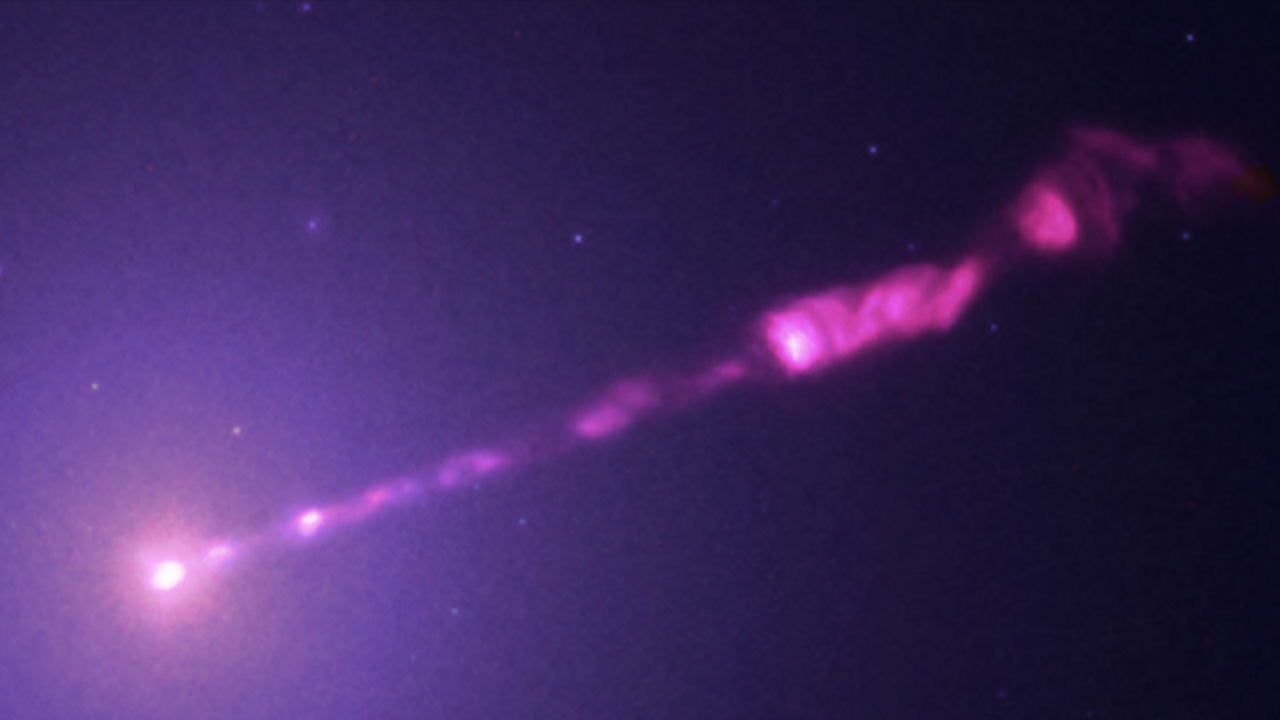
NASA's Chandra X-ray Observatory has captured unprecedented images of a jet erupting from M87, the supermassive black hole first directly photographed by the Event Horizon Telescope in 2019. The new observations reveal fine-scale details in the jet's structure that previous X-ray studies could not resolve.
M87 sits at the center of the Virgo A galaxy, roughly 55 million light-years from Earth. The black hole, weighing 6.5 billion times the mass of our sun, launches jets of material at nearly light speed. Researchers detected rapid changes in the jet's brightness and structure using Chandra's advanced X-ray imaging capabilities.
"We could already see changes in the jet, but never with this level of detail in X-rays," researchers noted in Space.com's reporting on the findings. The Chandra observations expose the jet's composition and behavior with clarity that ground-based instruments and earlier space telescopes lacked.
The data helps scientists understand how supermassive black holes accelerate particles to extreme energies. The jets release tremendous power across the electromagnetic spectrum, from radio waves to gamma rays. Studying M87's jet provides insights into similar jets emanating from black holes throughout the universe.
The Event Horizon Telescope's 2019 image of M87's shadow marked a watershed moment in astronomy, confirming predictions from general relativity. That breakthrough brought M87 into sharp focus for follow-up observations. Space agencies subsequently trained multiple telescopes on the target, creating a comprehensive multiwavelength portrait.
Chandra's X-ray vision complements observations from radio telescopes and other instruments. The combination reveals how jets evolve on short timescales, measured in days or weeks. Such rapid variability indicates complex physics near the black hole's event horizon, where gravity becomes extreme.
These findings appear relevant to