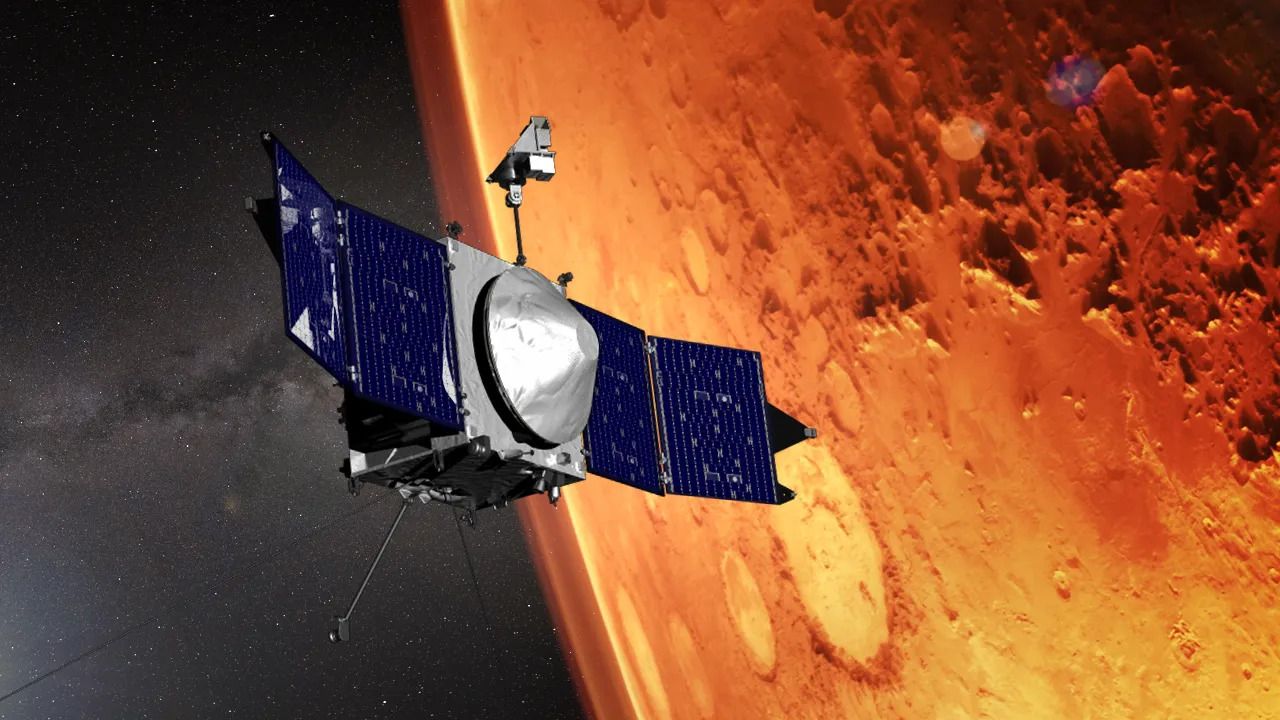
NASA retired the MAVEN orbiter on June 8, 2024, ending an 11-year mission that fundamentally transformed our understanding of Mars' atmospheric loss. The spacecraft's discoveries explained how the Red Planet transitioned from a wet, potentially habitable world to the cold desert it is today.
Launched in 2013, MAVEN (Mars Atmosphere and Volatile Evolution) orbited Mars to study the upper atmosphere and its interaction with solar wind. The mission revealed that solar wind strips away Mars' atmosphere at a rate of roughly 100 grams per second. This process accelerated dramatically over billions of years, causing Mars to lose most of its thick atmosphere and the liquid water that once flowed across its surface.
"Best. Mars. Mission. Ever." became the rallying cry from the scientific community celebrating MAVEN's contributions. The orbiter's instruments measured atmospheric composition, ionosphere properties, and solar particle interactions with unprecedented precision. Researchers used these measurements to model how atmospheric escape occurred throughout Mars' history, providing crucial context for the planet's climate evolution.
Beyond its scientific achievements, MAVEN served as a critical communications relay for NASA's Curiosity and Perseverance rovers on the Martian surface. The spacecraft received data from the rovers and transmitted it back to Earth, supporting extended surface operations that continue today.
The mission cost $571 million and operated well beyond its planned two-year primary mission. Scientists at the University of Colorado Boulder, NASA's Goddard Space Flight Center, and other institutions conducted the research. MAVEN's data continues to inform our understanding of planetary atmospheres and how celestial bodies lose them to space.
NASA decommissioned MAVEN by raising its orbit to prevent collisions with future Mars spacecraft. The decision to retire the orbiter reflects confidence in newer communication systems and the scientific goals achieved. The mission's legacy will influence Mars exploration strategies for decades, particularly regarding humanity