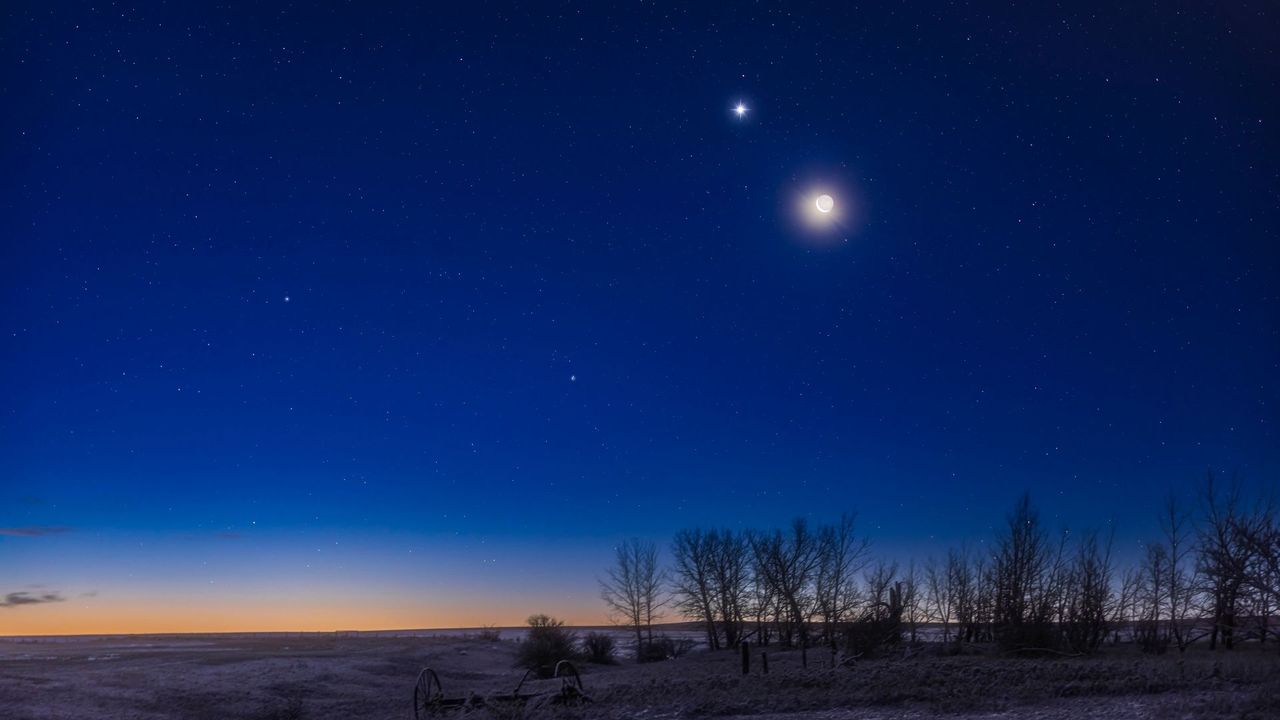
Skywatchers will witness an striking celestial alignment on June 17 when a crescent moon leads three bright planets across the night sky. Jupiter, Venus, and Mercury will cluster near the lunar crescent as it passes through the Beehive open star cluster, creating what observers call a "planet parade."
The Beehive cluster, also known as Messier 44 or Praesepe, sits in the constellation Cancer. This grouping of roughly 1,000 stars remains visible to the naked eye under dark skies, appearing as a fuzzy patch about the width of the full moon.
The alignment occurs as celestial mechanics place these objects in close proximity from Earth's perspective, though they remain vastly separated in space. Venus shines as the brightest planet visible from Earth, while Jupiter ranks second. Mercury, closer to the sun, presents a trickier viewing target but becomes easier to spot when positioned near brighter objects like Venus.
The crescent moon's phase during this period matters for visibility. A thin crescent offers less glare than a fuller moon, allowing surrounding stars and planets to stand out more clearly against the darkening sky. Observers should look toward the western horizon shortly after sunset for optimal viewing.
This event requires no special equipment. Binoculars enhance the view of the Beehive cluster's individual stars, but the alignment of planets and moon remains visible to unaided eyes from reasonably dark locations away from significant light pollution.
Such planetary alignments occur regularly but capture public attention because they concentrate several bright objects in a single region of sky. These events serve as compelling reminders of our place within a dynamic solar system where orbital mechanics occasionally create striking visual arrangements from our perspective on Earth.