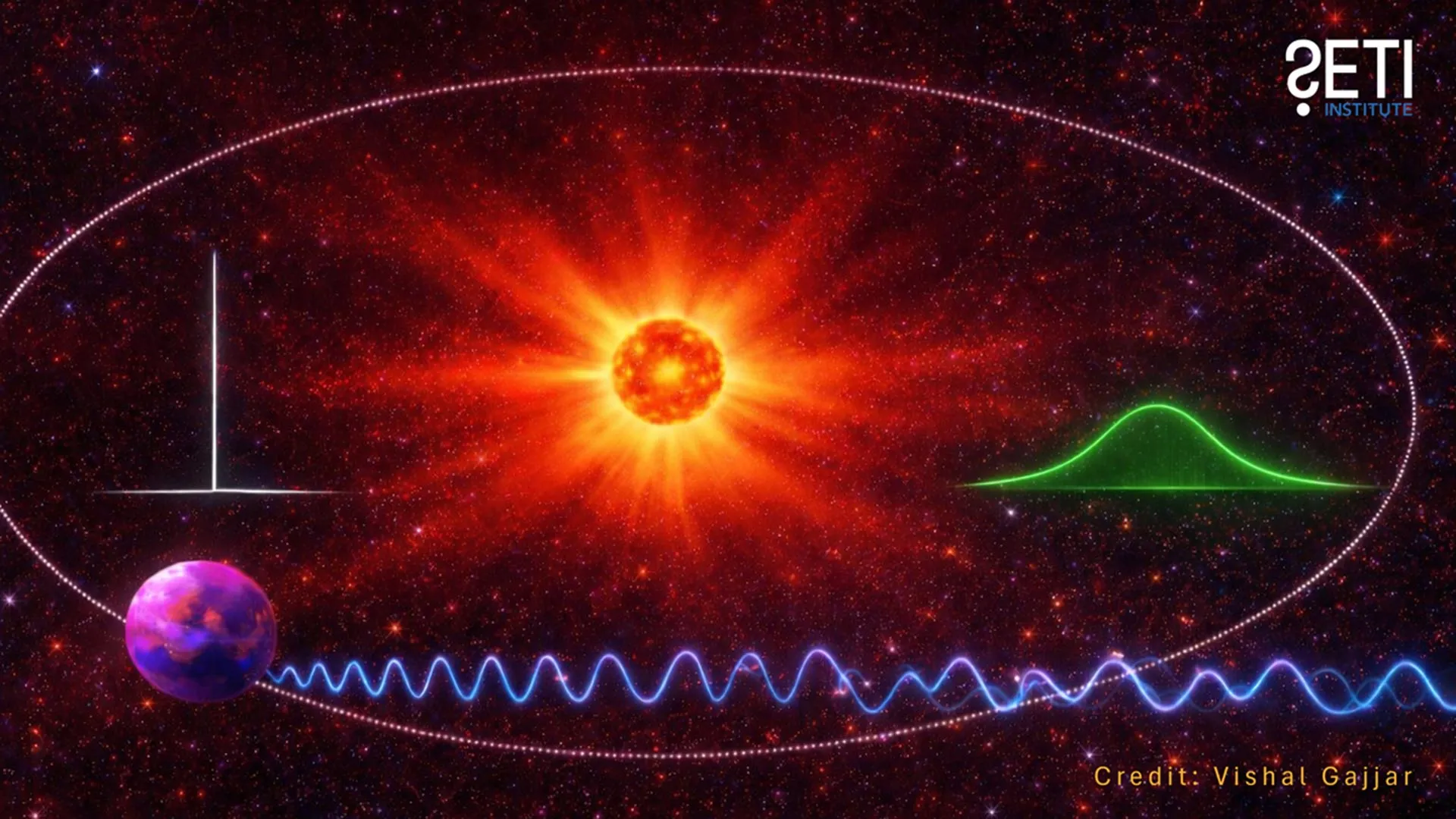
Scientists may be missing extraterrestrial messages because stellar interference scrambles alien signals before they reach Earth, according to new research from the Search for Extraterrestrial Intelligence (SETI) Institute.
The study identifies a previously overlooked obstacle in detecting distant civilizations. Turbulent plasma surrounding stars and powerful stellar storms distort ultra-narrow radio transmissions, spreading them across a wider range of frequencies. This broadening makes signals substantially harder for conventional detection equipment to identify.
The effect poses particular challenges around M-dwarf stars, which comprise the majority of stars in the Milky Way. These small, cool stars host frequent and intense magnetic activity that disrupts outgoing signals from any planets orbiting them. A civilization transmitting from an M-dwarf system would face significant natural interference in broadcasting their message to the galaxy.
This research reframes a central problem in SETI work. For decades, scientists have assumed that if advanced civilizations existed and deliberately transmitted radio signals, we would detect them with our current technology. The new findings suggest this assumption requires revision. Alien transmitters operating near active stars may produce signals that simply appear as noise to Earth-based instruments tuned to receive narrow-band transmissions.
The implications reshape how astronomers should approach the search. Rather than discarding scattered signals as instrument error or natural interference, researchers may need to develop new detection methods that account for stellar broadening effects. This could involve analyzing signal patterns differently or pointing instruments toward regions where such dispersion is most likely.
The discovery also raises questions about how any advanced civilization would overcome this limitation. They might intentionally broadcast stronger signals, design transmitters to compensate for stellar interference, or choose frequencies less affected by plasma distortion. Alternatively, they might communicate through methods humans haven't yet considered monitoring for.
This work highlights how technological limitations and astrophysical realities interact to constrain our search. We may inhabit