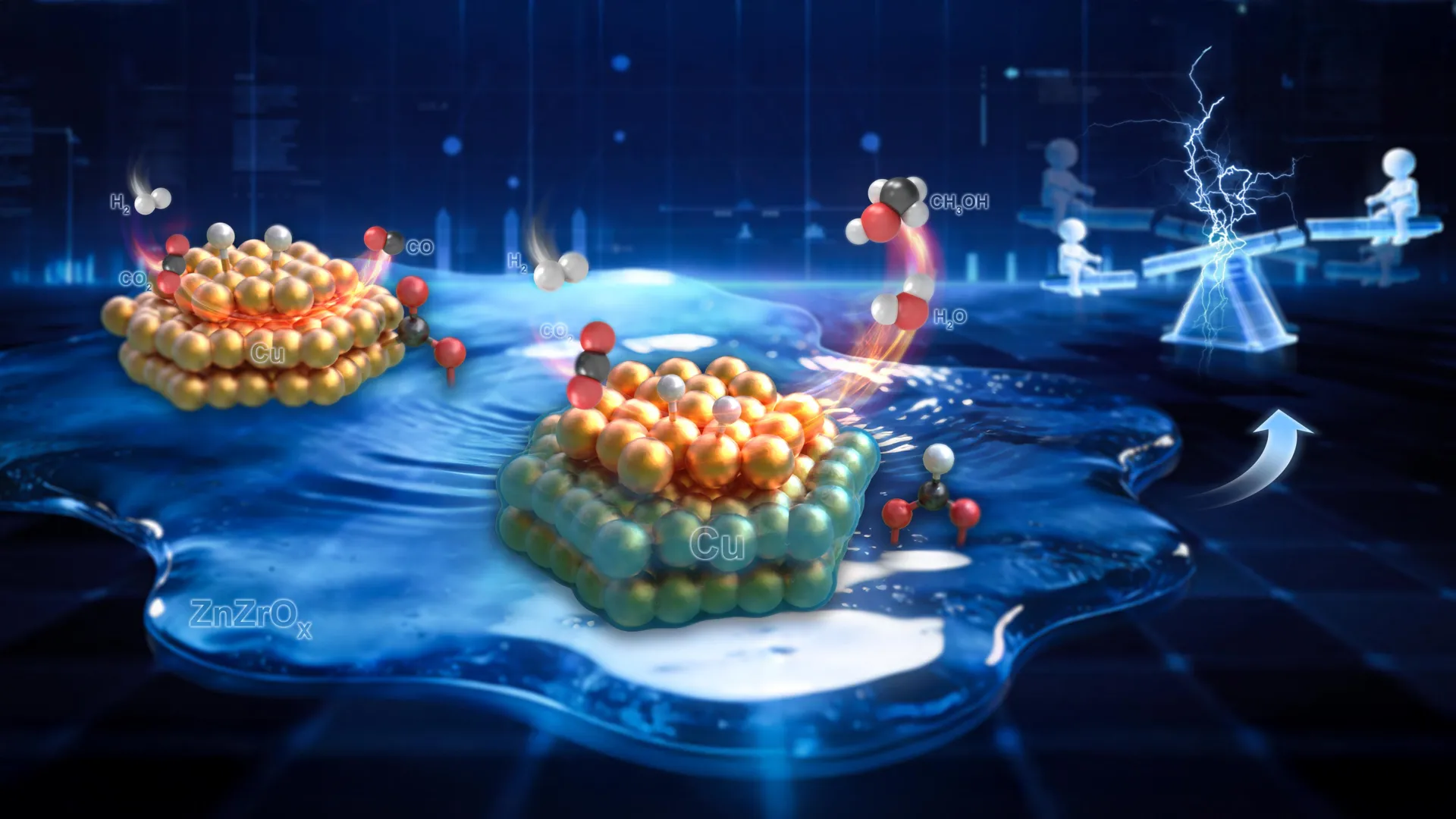
Researchers have developed a catalyst that triples methanol production from carbon dioxide, overcoming a fundamental limitation that has hindered CO2 conversion for decades. The breakthrough avoids the long-standing trade-off between reaction speed and efficiency that plagued previous approaches.
The new catalyst design physically separates reaction steps across different catalyst sites. Previous catalysts forced competing chemical reactions to happen in the same location, creating a bottleneck. When one part of the reaction sped up, the other slowed down, capping overall efficiency. By spatially isolating these steps, the team eliminated this constraint.
The result delivers roughly three times more methanol than standard commercial catalysts under similar conditions. Methanol serves dual purposes in industry: as a fuel and as a chemical feedstock for producing plastics, resins, and other compounds.
The advance addresses a persistent challenge in carbon utilization. Converting CO2 into useful chemicals remains expensive and inefficient at scale, limiting its viability as a climate solution or industrial process. While carbon capture technology continues improving, the conversion step has been the real bottleneck. This catalyst brings practical CO2-to-methanol conversion closer to commercial feasibility.
The research appears scientifically sound in its approach, though deployment faces real-world hurdles. Industrial adoption requires catalysts that perform reliably at scale, withstand repeated use cycles, and remain cost-effective compared to traditional methanol synthesis from natural gas. The researchers do not specify these durability and economic metrics, which remain critical for commercial viability.
The work represents genuine progress in heterogeneous catalysis and chemical engineering. Separating active sites to avoid reaction competition is a concept with broader applications beyond methanol synthesis. Other CO2 conversion processes might benefit from similar design principles.
This discovery enters a competitive field. Multiple teams globally pursue CO2 utilization through different chemical pathways and catalyst designs. Success ultimately depends