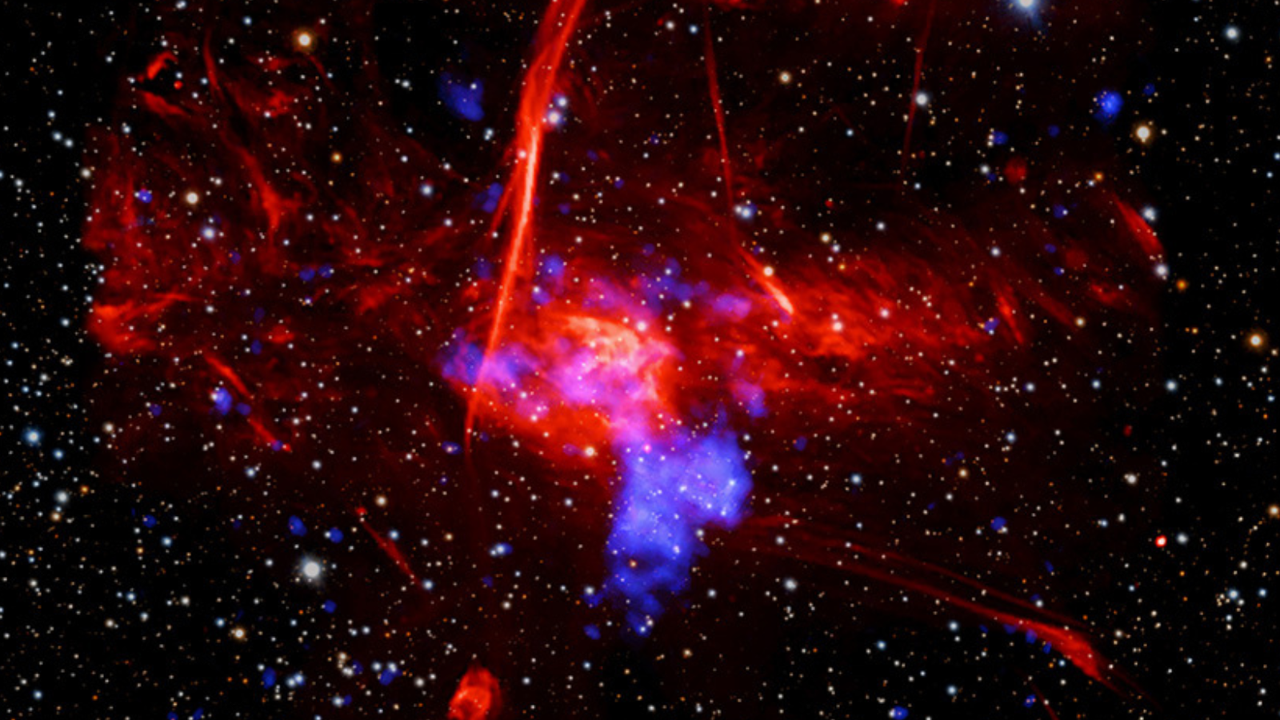
NASA's Chandra X-ray Observatory has identified the remnant of a supernova explosion that occurred approximately 1,700 years ago near the center of the Milky Way. The discovery reveals debris from a dead star traveling at 2 million miles per hour through space.
The Chandra spacecraft, which observes the universe in X-ray wavelengths, detected the energetic signature of this ancient explosion. X-ray observations excel at capturing high-energy phenomena like supernova remnants, where material continues radiating heat and energy long after the initial blast. The star's outer layers, violently ejected during the explosion, remain visible as an expanding shell of hot gas and particles accelerating across the galactic center.
The supernova's location near the Milky Way's core places it in one of the most complex regions of our galaxy, where gravitational forces and magnetic fields interact intensely. Dating the explosion to roughly 1,700 years ago relies on measuring the expansion rate of the debris cloud and calculating backward to the initial detonation event. The extreme velocity of 2 million miles per hour underscores the tremendous energy released when the stellar explosion occurred.
Supernova remnants serve as natural laboratories for studying stellar physics and the processes that distribute heavy elements throughout galaxies. When massive stars or white dwarfs explode, they scatter elements like iron, nickel, and oxygen into the surrounding space, enriching the interstellar medium. Future stars and planets eventually form from this enriched material.
The Chandra X-ray Observatory, launched in 1999, continues providing unprecedented detail in X-ray astronomy after more than two decades of observations. Its advanced instruments resolve fine structures in hot gas and energetic phenomena invisible to optical telescopes. Discoveries like this supernova remnant contribute to astronomers' understanding of stellar death and the dynamic processes shaping