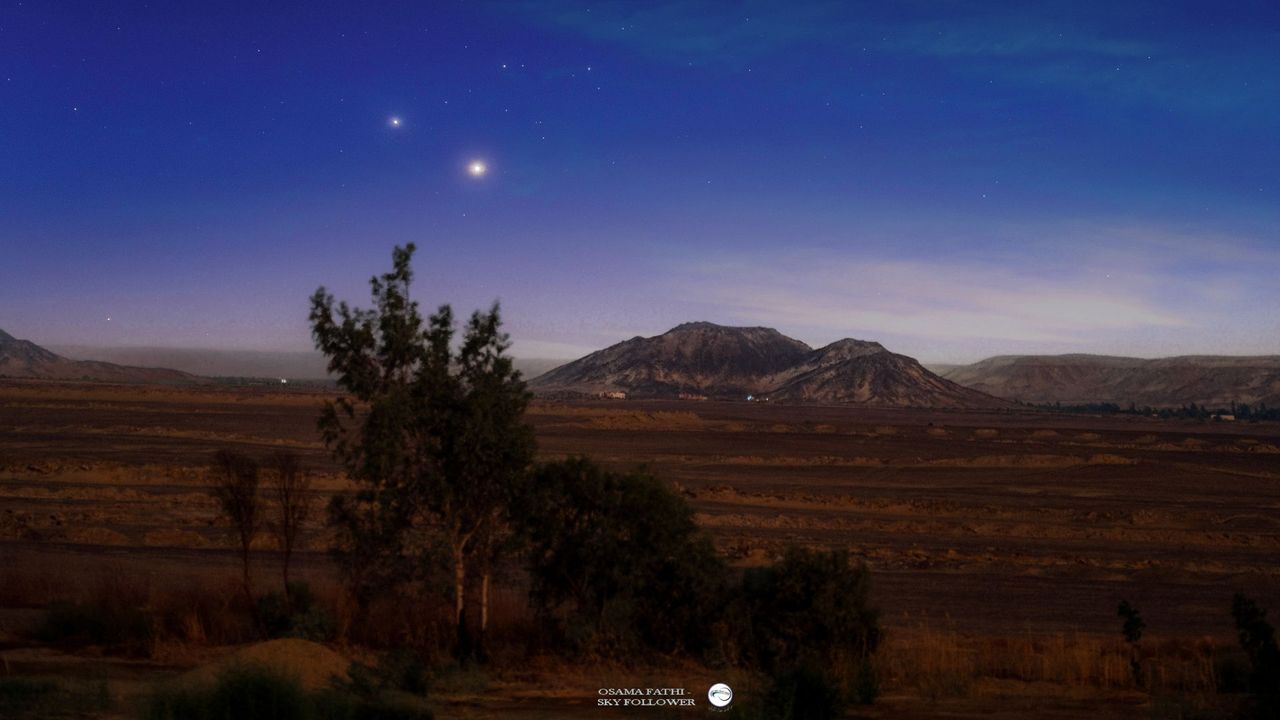
# Jupiter and Venus Stage Celestial Close Encounter
Venus and Jupiter moved into close proximity this week, creating a rare planetary conjunction visible across Earth's night sky. The two brightest planets in our solar system aligned in a way that made them appear unusually near each other from ground-level observation points.
Planetary conjunctions occur when two celestial bodies reach the same longitude as viewed from Earth. While the planets remain millions of kilometers apart in actual space, their alignment from our perspective creates dramatic viewing opportunities. Venus and Jupiter conjunctions rank among the most visually striking planetary events because both worlds shine with exceptional brightness, making them easily visible to the naked eye even in moderately light-polluted areas.
The event drew attention from amateur astronomers and professional photographers worldwide, who captured images of the planets positioned close together against the backdrop of stars and the surrounding sky. Astrophotographers took advantage of clear weather windows across multiple continents to document the alignment through telescopes and wide-angle lenses.
Jupiter, the solar system's largest planet, appears as a pale yellowish disk when viewed through modest magnification. Venus, Earth's closest planetary neighbor, shines with a brilliant whitish glow due to its thick cloud cover reflecting sunlight back toward us. The contrast in their appearance and relative brightness creates compositionally interesting photographs.
Such conjunctions serve as accessible entry points for people who rarely observe the night sky. They require no special equipment and occur predictably enough that astronomy enthusiasts can plan ahead to find good viewing locations away from artificial light. These events also remind observers of the mechanical nature of our solar system, where orbital motions bring planets into temporary alignment with clockwork regularity.
The conjunction passed within days, as the planets continued their respective orbits around the sun at different speeds. Jupiter moves more slowly through the zodiacal constellations than Venus, meaning the faster inner planet gradually pulled ahead and the visual spectacle f