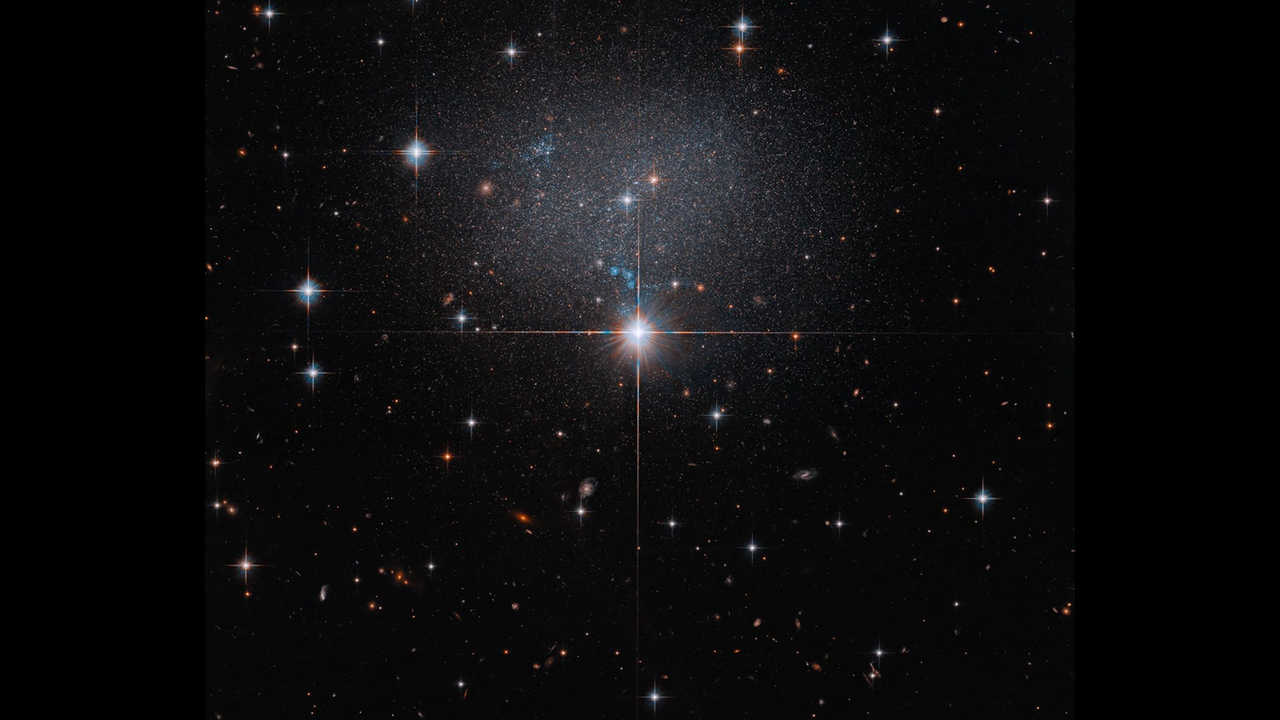
The Hubble Space Telescope has captured a detailed image of an unusual irregular galaxy filled with a dense cluster of stars. The observation reveals the chaotic structure of this faint celestial object, which lacks the organized spiral or elliptical patterns typical of most galaxies.
Irregular galaxies form through gravitational interactions with neighboring galaxies or past collisions. These cosmic encounters disrupt the orderly structure of star systems, scattering stars across space in seemingly random configurations. The galaxy Hubble observed exhibits this characteristic disarray, with stars distributed unevenly throughout its structure.
The telescope's advanced imaging capabilities allow astronomers to resolve individual stars within the galaxy, providing insights into stellar populations and star formation processes in unusual environments. Faint galaxies like this one present particular challenges for observation because they emit less light than spiral galaxies like the Milky Way, making them harder to detect and study in detail.
Understanding irregular galaxies contributes to broader knowledge about galaxy evolution and the role of environmental factors in shaping cosmic structures. These systems offer natural laboratories for studying how gravitational interactions reshape galaxies over time. The Hubble observations help astronomers track the lifecycle of galaxies from formation through disruption and potential reformation.
This image represents the type of discovery that showcases Hubble's continued value to astronomy decades after its launch in 1990. The space telescope remains essential for high-resolution observations of distant objects that ground-based instruments cannot clearly resolve. Astronomers continue to use Hubble to catalog and study unusual galaxies that challenge existing theories about how galaxies form and evolve across cosmic time.