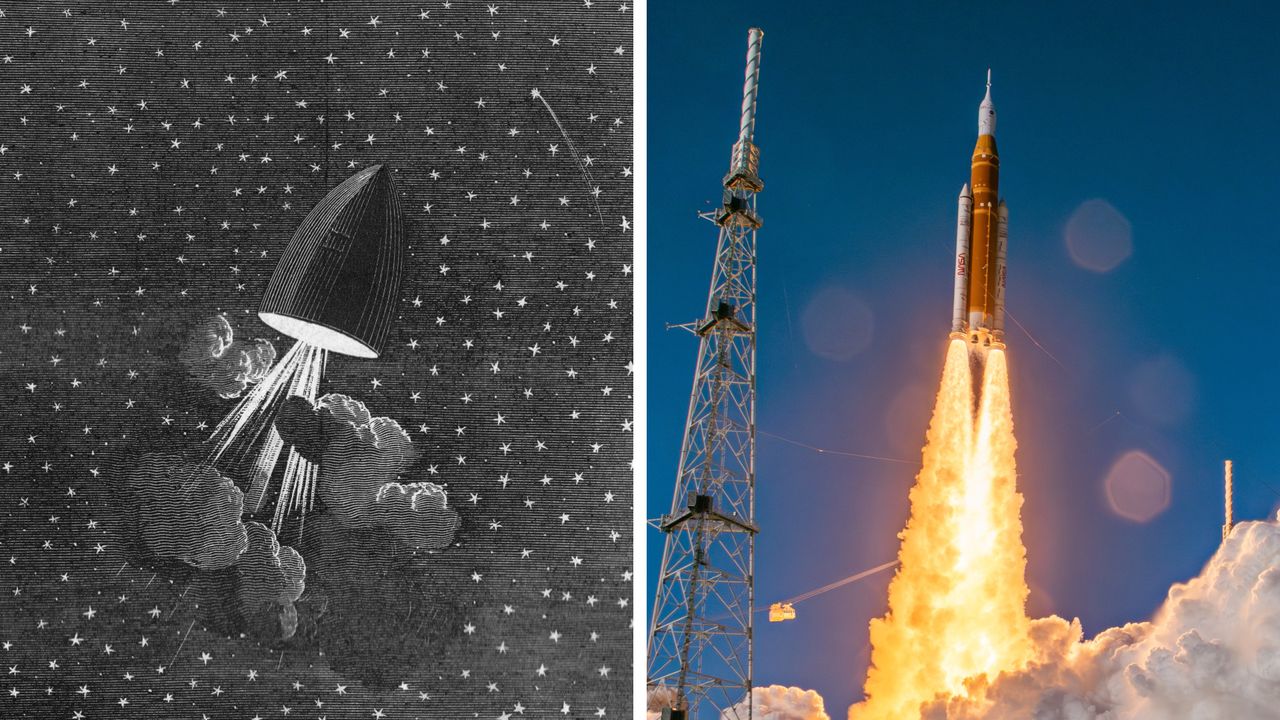
Jules Verne's 1860s lunar fiction contained striking parallels to NASA's modern Artemis 2 mission, demonstrating the French author's prescient understanding of spaceflight mechanics nearly 160 years before the mission launches.
In "From the Earth to the Moon" and its sequel "All Around the Moon," Verne described three travelers in a cone-shaped capsule following a free-return trajectory around the moon. That same basic architecture defines Artemis 2. The mission will carry three astronauts in NASA's Orion capsule on a path that loops around the lunar body without entering orbit, then returns to Earth using the moon's gravity for the return leg.
Verne worked without computers, wind tunnels, or modern physics. Yet he grasped fundamental orbital mechanics. His capsule design anticipated the blunt-end, heat-resistant geometry that protects modern spacecraft during atmospheric reentry. His trajectory concept matched what orbital engineers would later formalize as a free-return lunar trajectory, a path that requires no mid-course corrections to return safely to Earth.
The similarities extend beyond hardware. Verne populated his mission with a crew of three, matching Artemis 2's astronaut count. He envisioned a journey lasting roughly ten days, close to Artemis 2's planned duration.
This convergence reveals something about spaceflight fundamentals. The physics of lunar trajectories and reentry dynamics do not vary with time. Once those equations were solved, any rational approach to moon missions would arrive at similar solutions. Verne's genius lay in recognizing those constraints and working within them logically.
Verne did miss elements. He knew nothing of radiation belts, trajectory correction burns, or life support systems as they actually function. His fictional propellant and launch dynamics bore little resemblance to chemical rocketry as it developed. But