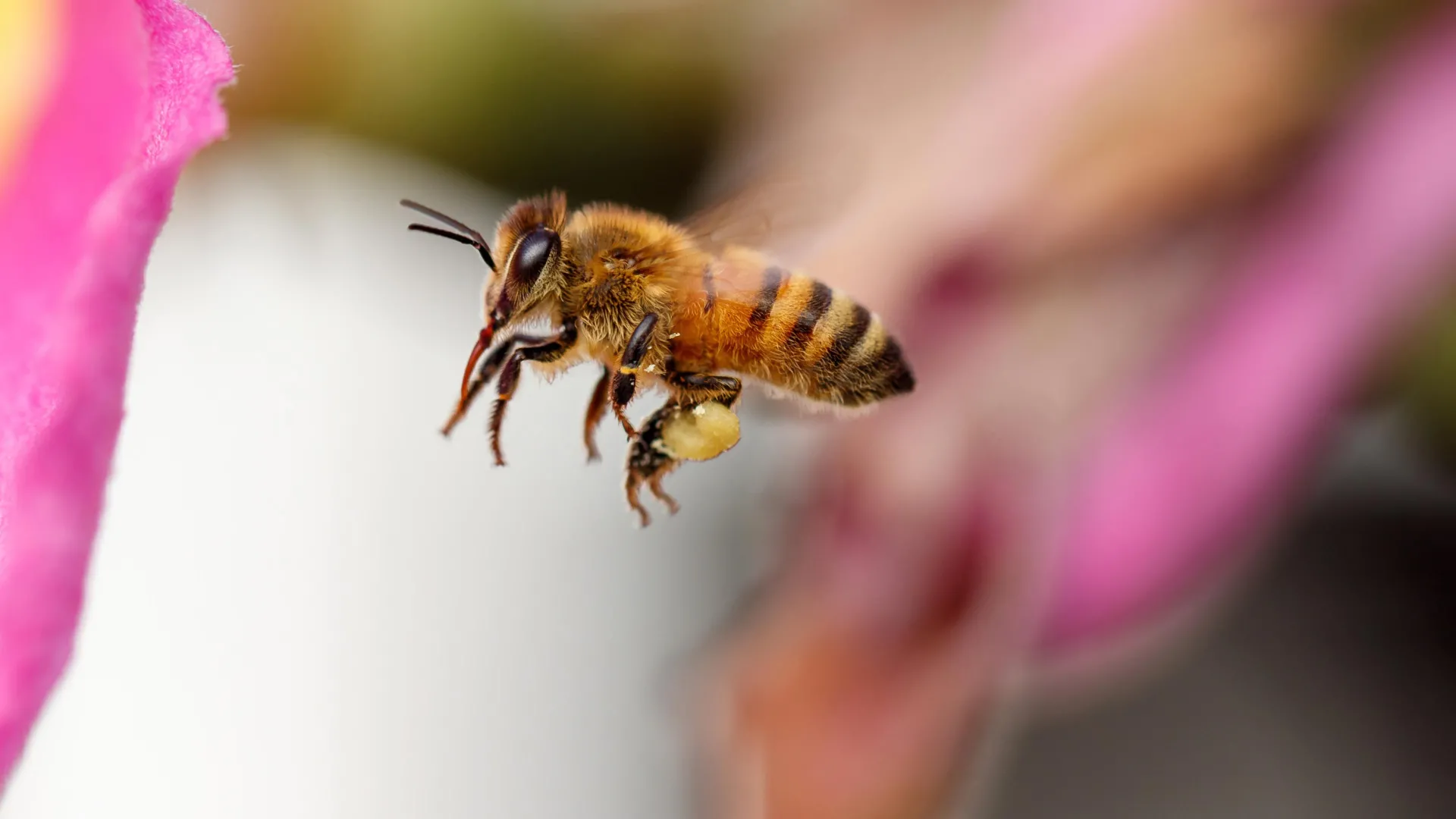
Honey bees navigate their environment with remarkable consistency, following individual flight paths so precise they repeat routes within centimeters, according to research using drone-based tracking systems.
Scientists outfitted bees with tracking equipment and monitored their movements in natural settings. The data revealed that each bee maintains its own preferred trajectory between its hive and foraging sites. Some individuals demonstrated extraordinary precision, flying nearly identical paths on successive trips through three-dimensional space.
The study identified landmarks as critical navigation anchors. Trees, buildings, and other distinctive visual features helped bees maintain their chosen routes. In contrast, uniform landscapes such as cornfields showed greater variation in flight paths, suggesting bees rely on visual reference points to lock in their trajectories.
This finding expands understanding of bee cognition and navigation behavior. Previous research established that bees use multiple orientation strategies, including sun-compass navigation and visual memory. This work demonstrates they also develop personalized spatial maps and execute them with striking fidelity.
The drone-based tracking methodology represents a significant advance over traditional observation techniques. It captures three-dimensional movement data without the limitations of tethered experiments or direct observation, allowing researchers to study bees in their actual foraging environment.
The precision of these flight paths carries practical implications. Understanding bee navigation could inform conservation strategies by revealing how landscape features influence colony success. Uniform agricultural areas with few landmarks might present navigational challenges that reduce foraging efficiency.
Further research could examine whether bees teach younger nestmates their established routes or whether each bee develops unique paths independently. The energy expenditure of maintaining precise trajectories compared to more variable flight also deserves investigation.
The work underscores that even small insects possess sophisticated spatial cognition and motor control capabilities. Individual behavioral variation in navigation may contribute to colony resilience, with different bees exploring different routes and discovering new resources.