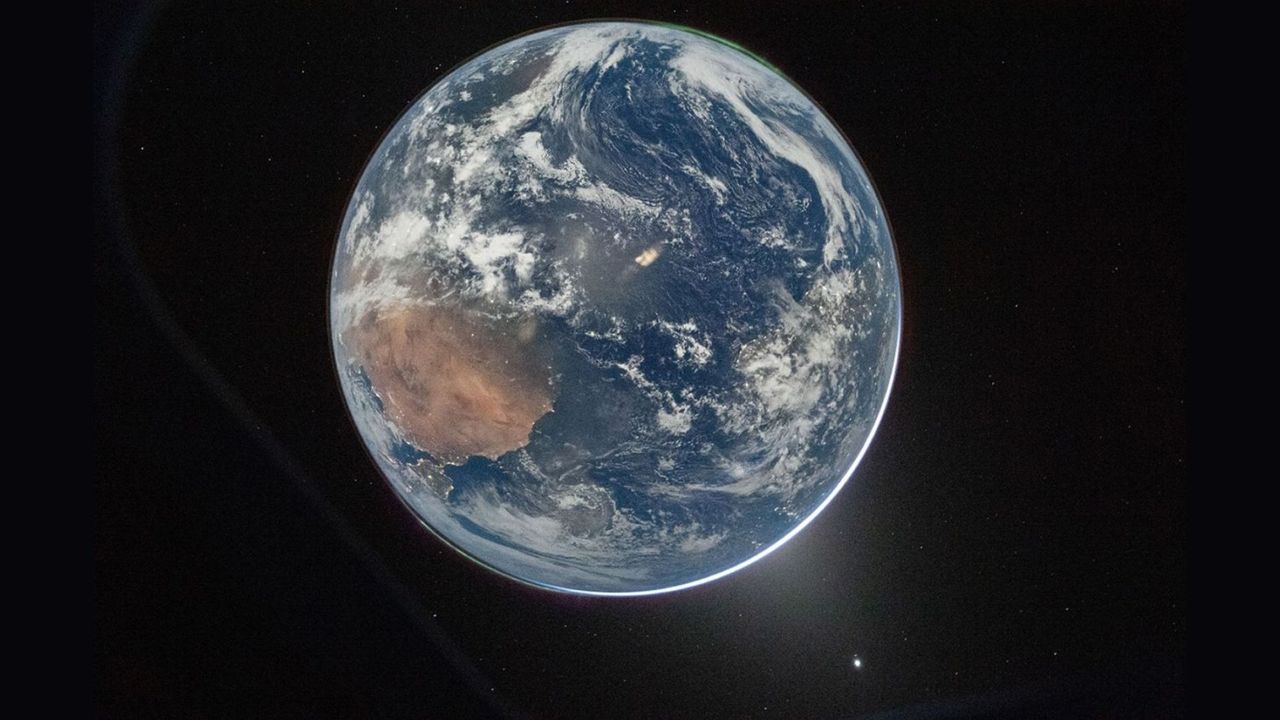
Astronauts aboard NASA's Artemis II mission photographed a rare double aurora phenomenon over Earth's nightside during their journey toward the moon. The four crew members captured the unusual display as they departed Earth orbit, documenting a natural light show that occurs when solar wind particles interact with the planet's magnetic field and atmosphere.
Double auroras form when the aurora borealis and aurora australis appear simultaneously in both hemispheres, connected by magnetic field lines. This occurs during geomagnetic storms when increased solar activity pumps energy into Earth's magnetosphere. The Artemis II astronauts held a unique vantage point. Their position in space, traveling away from Earth toward the moon, allowed them to observe both auroral ovals at once, a view rarely captured from spacecraft.
The Artemis II mission represents NASA's test flight for its lunar exploration program. The four crew members, selected for their expertise, traveled beyond Earth orbit as a dress rehearsal for eventual moon landings. Their photography documentation adds valuable observational data to auroral science during their transit.
Auroras remain scientifically important for understanding Earth's space weather and magnetospheric dynamics. Researchers monitor auroral activity to predict geomagnetic storms and their potential effects on power grids, satellites, and communications systems. Ground-based observations typically capture individual auroral ovals, but spacecraft observations of simultaneous dual auroras remain rare and scientifically valuable.
The image represents more than a spectacular photograph. It demonstrates how space missions generate unexpected scientific data when crews remain alert to their surroundings. The Artemis II mission's primary objective focuses on testing systems and crew procedures for lunar return, but such incidental observations contribute to broader Earth science understanding.
This capture highlights the complementary relationship between human spaceflight and scientific research. Astronauts serve as trained observers with the ability to recognize and document transient phenomena that automated