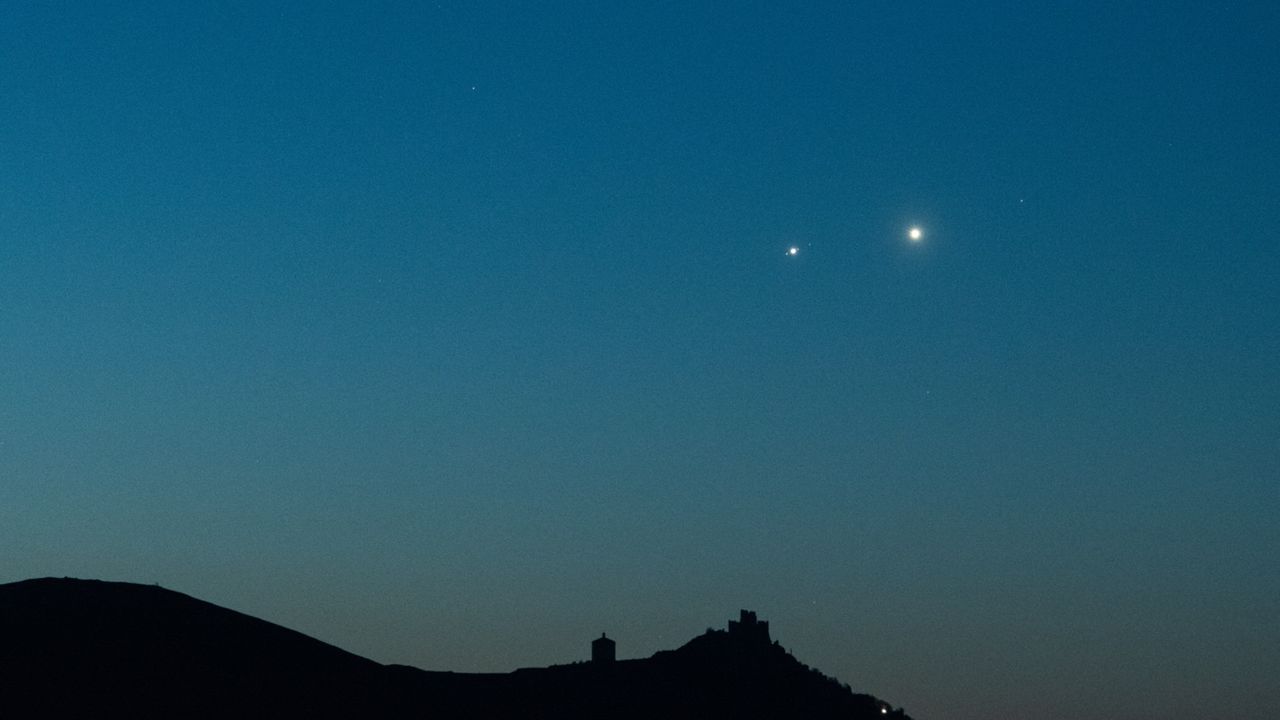
Venus and Jupiter appear to meet in Earth's sky with striking regularity, and astronomers have discovered this astronomical pattern reflects the same orbital dynamics that enable life on our planet.
The conjunctions occur because Venus and Jupiter follow orbital paths around the sun with specific geometric relationships. Venus orbits much closer to the sun than Jupiter, completing its circuit roughly every 225 Earth days while Jupiter takes 12 years. Their different orbital speeds create a periodic alignment where the two planets appear to converge from Earth's perspective. This happens roughly every 13 months.
The underlying cause involves orbital resonance, a phenomenon where celestial bodies' orbital periods maintain mathematical ratios to one another. The same gravitational architecture that produces these Venus-Jupiter conjunctions also shaped the broader solar system structure during its formation 4.6 billion years ago.
This architecture proves critical for Earth's habitability. The orbital spacing and masses of the inner planets create a stable system where Earth orbits in the habitable zone, receiving enough solar energy to support liquid water without becoming scorched. Jupiter's massive gravitational presence in the outer solar system deflects many asteroids and comets that might otherwise threaten Earth, providing additional protection for life.
The resonances that govern planetary orbits reflect the initial distribution of material when the solar system formed from a protoplanetary disk. Planets migrated into their current positions through gravitational interactions, settling into orbital patterns that minimized collisions and maximized stability. Venus and Jupiter's regular conjunctions serve as a visual reminder that our solar system's orderly geometry is not random.
Understanding why Venus and Jupiter meet predictably in our sky illuminates deeper questions about planetary formation and habitability elsewhere. Systems with different resonance patterns might produce unstable configurations where worlds orbit too close to their stars or too far away to support life. Earth's stable position represents just one solution among countless possibilities.
These celestial meetings, visible