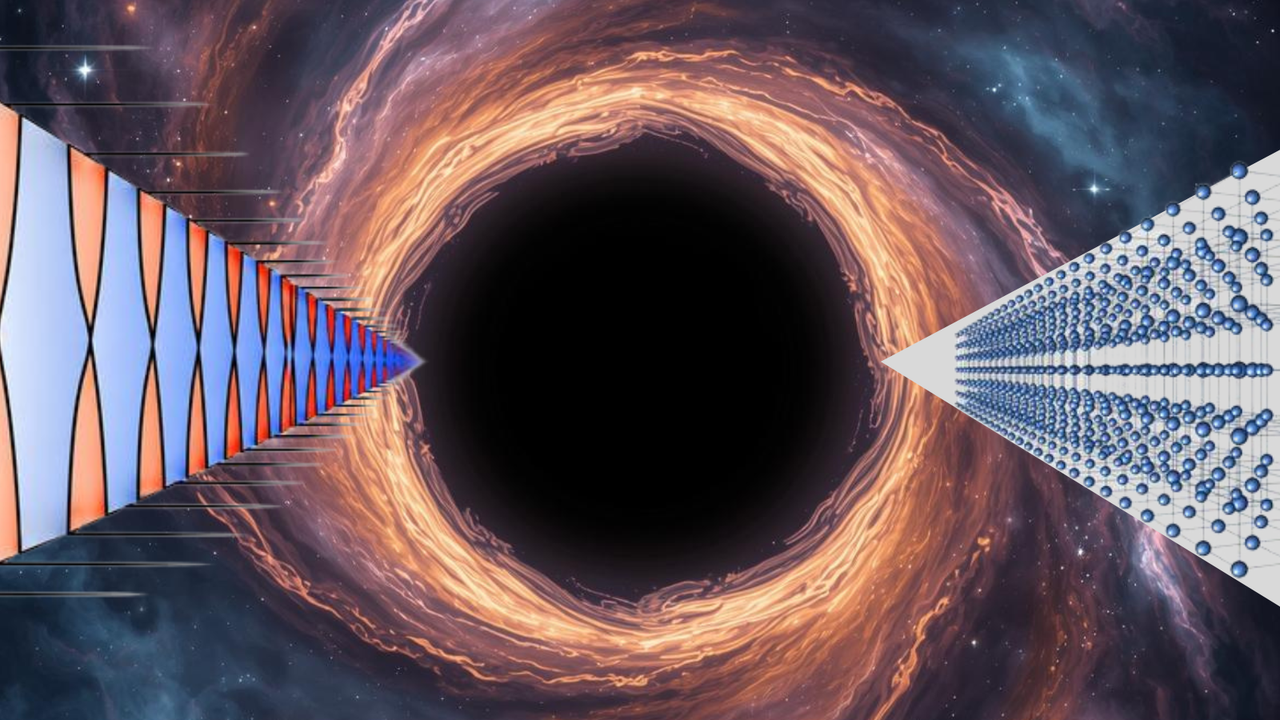
Theoretical physicists have proposed that spacetime itself could crystallize into exotic structures capable of producing miniature black holes, according to calculations developed entirely through mathematical analysis.
The team worked out the concept using only pen and paper methodology, deriving equations that describe how the fabric of space and time might undergo phase transitions similar to how water freezes into ice. These "spacetime crystals" would represent a fundamentally new state of matter at the intersection of quantum mechanics and general relativity.
The research suggests these crystalline structures could spontaneously generate microscopic black holes through their internal dynamics. The calculations indicate that under extreme conditions, the geometric properties of spacetime itself could reorganize into repeating, ordered patterns. When such reorganization occurs, the curvature of spacetime becomes so intense in localized regions that it collapses into black holes.
This work bridges two of physics' most challenging frontiers. General relativity describes gravity and large-scale cosmic structures. Quantum mechanics governs particles and subatomic physics. Most attempts to unify these frameworks require complex numerical simulations. This team's paper-and-pencil approach produced exact mathematical solutions describing the phenomenon.
The concept remains purely theoretical. No experimental evidence yet confirms spacetime crystallization exists. The extreme conditions required for such structures to form far exceed anything achievable in current laboratories. Even detecting remnants of primordial black holes created in the early universe remains unconfirmed.
The implications extend beyond black hole formation. If spacetime can crystallize, it suggests the universe contains far richer physical structures than standard models predict. Such phases might exist in the centers of neutron stars or in the quantum foam at the Planck scale, where quantum effects dominate gravity.
The work invites scrutiny from the theoretical physics community. Peer review will test whether the mathematical framework holds up and whether these spacetime crystals represent genuine physics or elegant mathematics disconnected