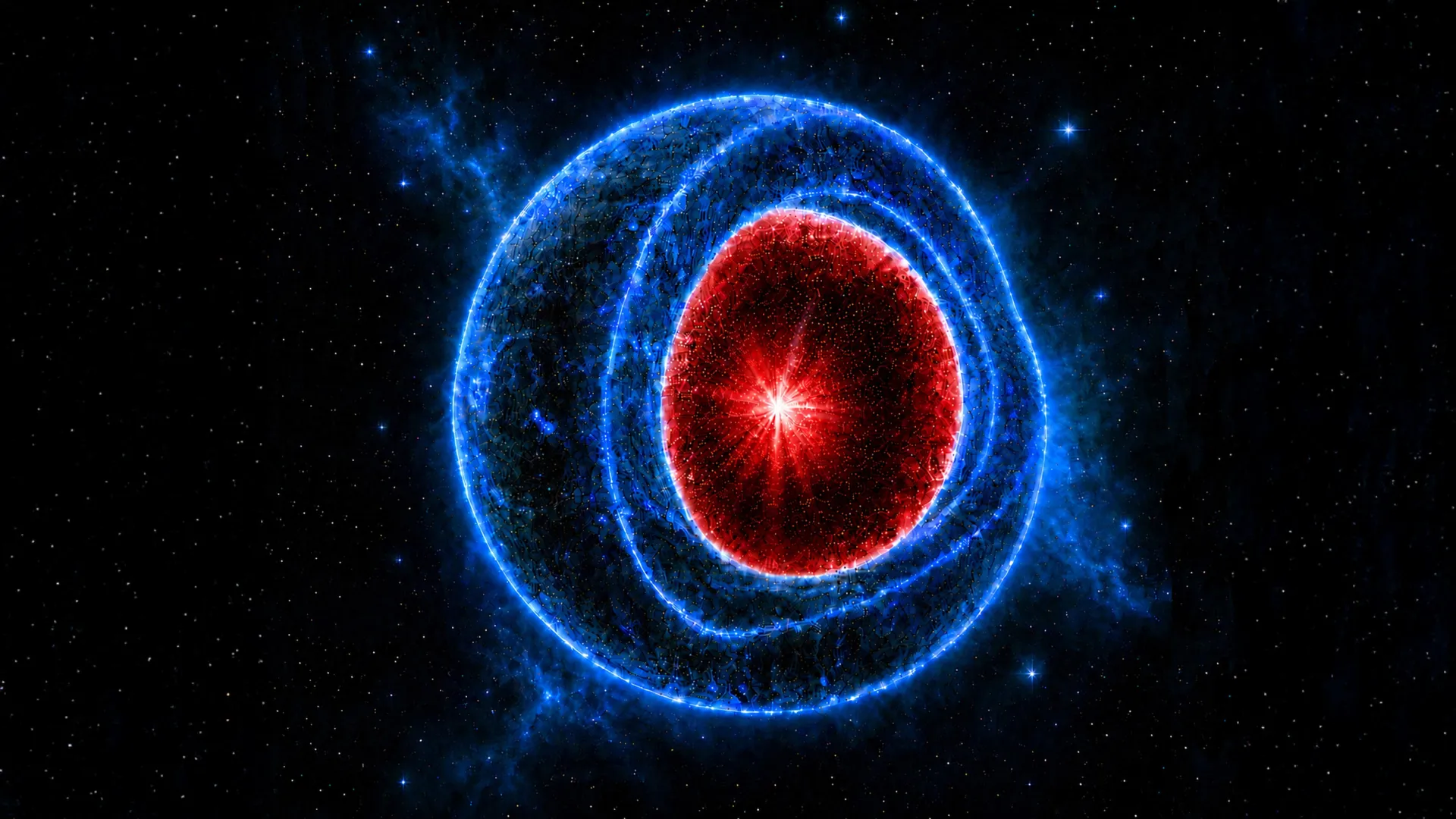
Researchers propose that collapsing massive stars might spawn pocket universes rather than black holes, according to a new theoretical study. When a star reaches the end of its life, conventional physics predicts gravitational collapse creates a singularity obscured by an event horizon. The new hypothesis flips this picture. Dark energy within the collapsing core could trigger the birth of a tiny universe inside the dying star. This miniature cosmos would expand outward, counteracting gravity and halting total collapse.
The result would be an exotic object called a gravastar, distinct from conventional black holes. The gravastar maintains an event horizon while avoiding the mathematical pathologies of infinite density singularities. Dark energy, the mysterious force accelerating cosmic expansion, provides the outward pressure needed to balance gravitational attraction. The expanding inner universe essentially inflates, creating sufficient repulsion to prevent matter from collapsing to a point.
This model addresses longstanding puzzles in theoretical physics. Black hole singularities create infinities that break down under quantum gravity. Gravastars sidestep these problems by replacing singularities with expanding universes. The proposal remains speculative and depends on mechanisms not yet observed.
Testing these ideas faces practical challenges. Distinguishing a gravastar from a black hole observationally proves difficult, as both possess event horizons. Detecting differences would require sophisticated gravitational wave observations or studying radiation from the immediate vicinity of compact objects. Current astronomical data cannot rule out gravastars, nor does evidence confirm their existence.
The theoretical framework builds on earlier work exploring alternatives to black hole singularities. Scientists continue developing models that reconcile general relativity with quantum mechanics at extreme densities. Whether dying stars actually produce gravastars or black holes remains an open question requiring both better theory and observational advances. The hypothesis illustrates how fundamental gaps in physics continue inspiring creative approaches to cosmic mysteries.