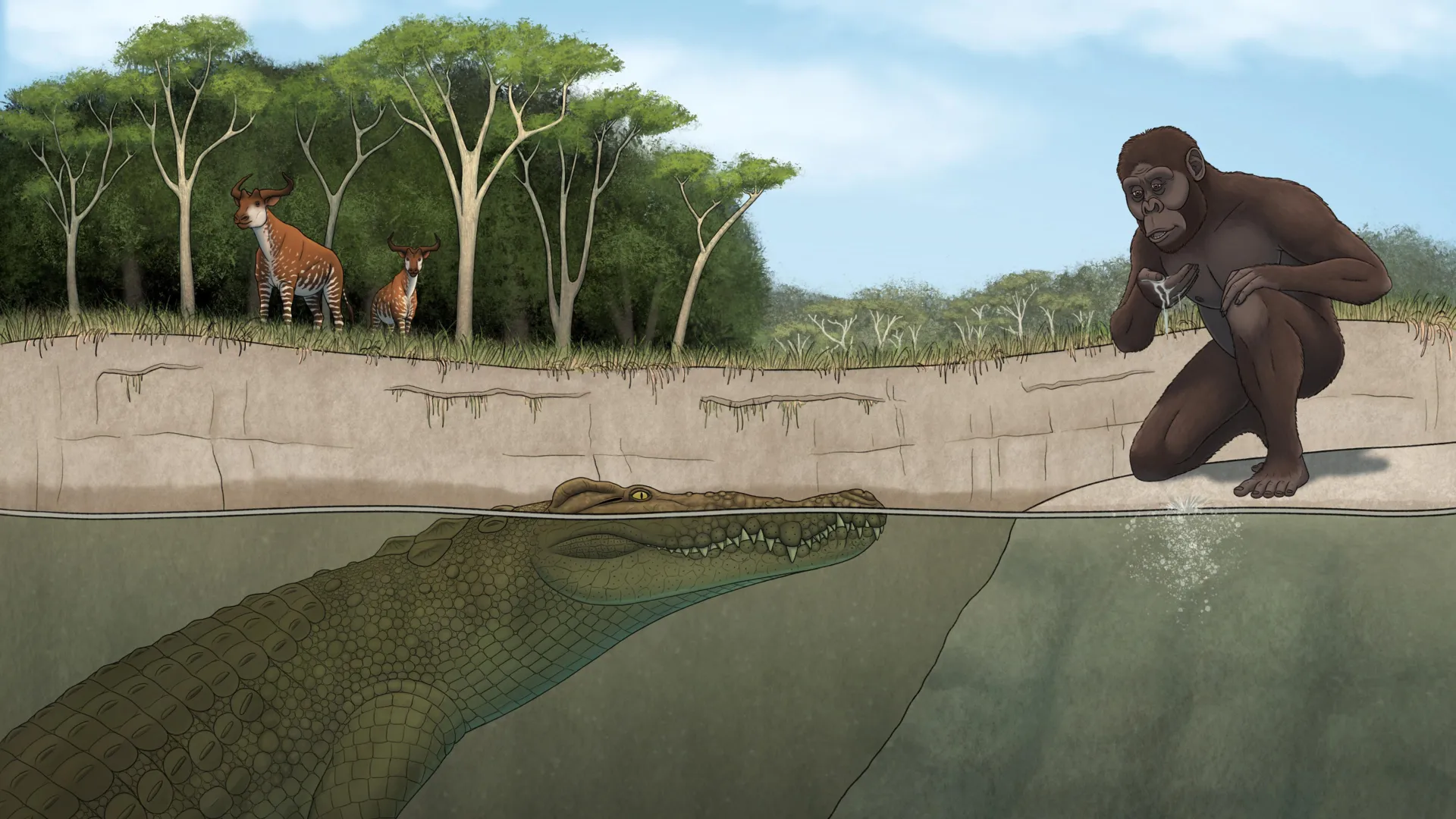
Researchers studying Ethiopian fossils have identified a previously unknown giant crocodile species that shared the landscape with Lucy's species (Australopithecus afarensis) over 3 million years ago. Paleontologists dubbed the crocodile "Lucy's hunter" for its coexistence and likely predatory relationship with early human ancestors in the region's river systems.
The crocodile appears to have been the apex predator of its ecosystem, regularly hunting in waterways where Lucy's relatives gathered to drink and forage. Its size and hunting prowess would have made it the most formidable threat these early hominins faced from the animal kingdom. The discovery comes from fossil evidence recovered in Ethiopia's Awash Valley, a region that has yielded numerous remains of Australopithecus afarensis, the species made famous by the "Lucy" skeleton discovered in 1974.
The identification of this new crocodile species provides direct evidence of the predatory pressures that shaped early human evolution. Paleontologists have long theorized that large predators played a role in driving behavioral and physical adaptations in our ancestors, including increased vigilance, group living, and tool use. This crocodile species represents the first concrete example of a major predator operating in the same environment as Lucy's species during this critical period.
The research underscores how early human ancestors navigated a dangerous world populated by creatures far larger and more powerful than themselves. Vulnerability to predation likely influenced where these hominins traveled, when they were active, and how they organized socially. Understanding the predator-prey dynamics of ancient ecosystems provides context for interpreting the fossil record and reconstructing the selective pressures that drove human evolution.
The discovery demonstrates the value of detailed paleontological fieldwork in Ethiopia, a region that continues to yield invaluable insights into human origins. Each new species documented in Lucy's