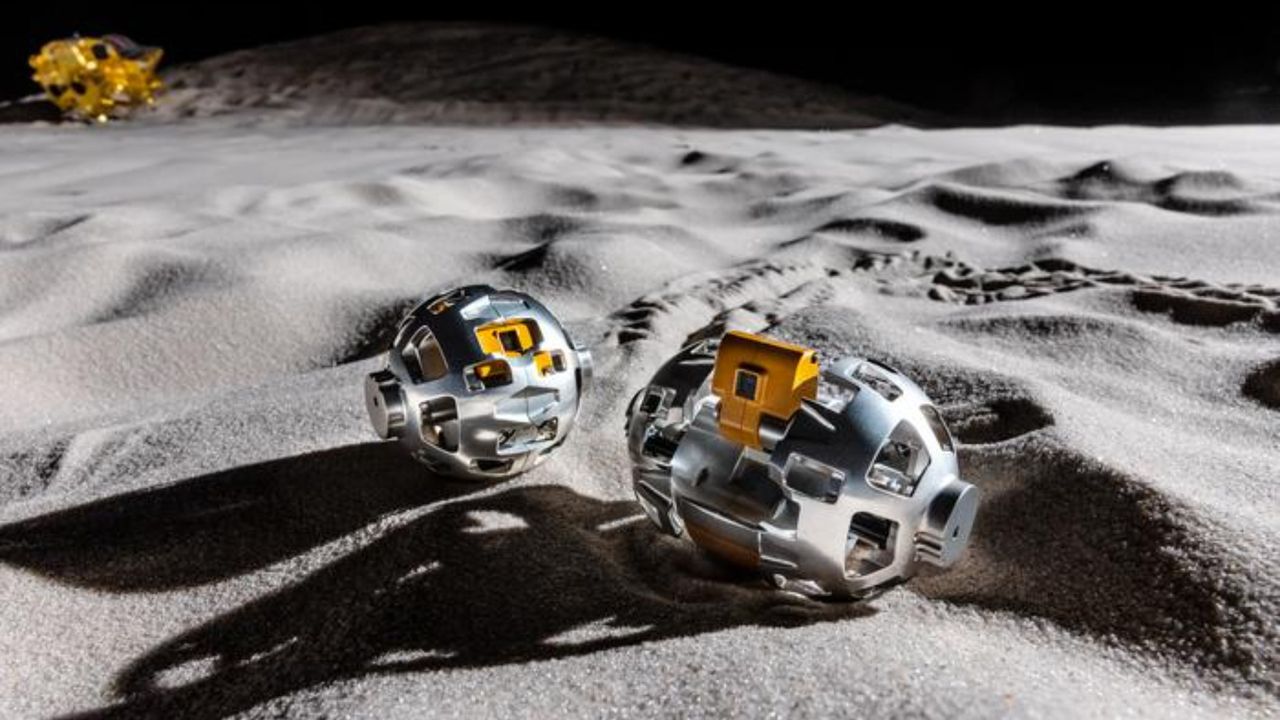
Japanese scientists deployed a transforming rover on the moon in 2024 that shifts from a sphere into a wheeled robot, marking the first time such a shape-changing lunar explorer operated on another world.
The rover, developed by researchers at the Japan Aerospace Exploration Agency (JAXA) and collaborators, completed its mission objectives during a brief lunar exploration window. The sphere-to-robot transformation allows the craft to navigate difficult terrain more effectively than traditional rover designs. In its spherical form, the rover can roll across uneven surfaces and descend slopes. Once deployed in its robot configuration, it deploys wheels for more precise movement and scientific investigation.
The mission demonstrated autonomous operation in lunar conditions, including navigating shadows, craters, and regolith. Engineers designed the rover to operate independently for extended periods without direct human control, adapting to obstacles and adjusting its path in real time. This autonomy proves essential for lunar exploration, where communication delays make remote operation impractical.
The compact design addresses a persistent challenge in lunar robotics. Traditional rovers require significant energy and mechanical systems to traverse rough terrain. The transforming approach reduces mass while expanding operational flexibility. Scientists gathered data on the lunar surface composition and environment during the mission.
JAXA selected this innovative design after studying how biological organisms adapt to challenging environments. The sphere configuration minimizes damage from impacts during landing and initial exploration, while the robot mode enables detailed scientific work.
The 2024 mission represents a significant step beyond the wheeled rovers deployed by Apollo astronauts and robotic missions from China, India, and other nations. It validates shape-changing robotics as a viable strategy for extraterrestrial exploration. Future lunar and planetary missions may incorporate similar transformable designs to expand exploration capabilities while reducing payload requirements.
This achievement opens new possibilities for exploring environments where terrain variability demands adaptive locomotion. Agencies planning missions to Mars and beyond now have practical