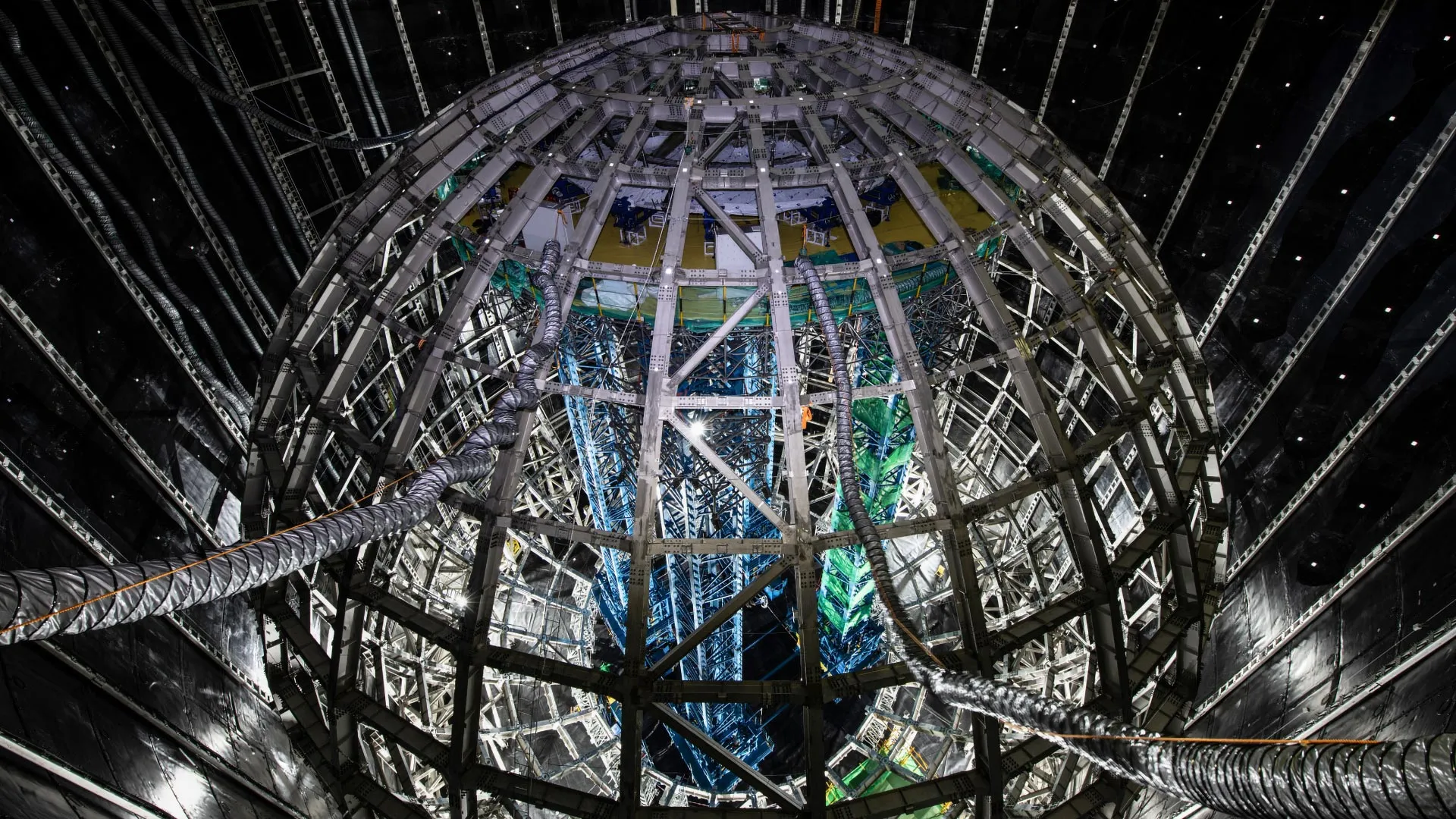
The JUNO neutrino observatory in China has achieved its first major scientific breakthrough, using just 59 days of data to deliver one of the most precise measurements yet of how neutrinos transform as they travel through space.
The detector has sharpened measurements of critical neutrino oscillation parameters, the quantum mechanical phenomenon where neutrinos swap between different types. This precision directly addresses one of particle physics' most stubborn unsolved problems: establishing the true mass hierarchy of neutrinos, or determining which neutrino types are heavier or lighter than others.
Neutrinos rank among the universe's most abundant yet elusive particles. Trillions stream through Earth every second, barely interacting with matter. Their oscillation behavior, discovered in 1998 by Takaaki Kajita and Arthur McDonald (Nobel Prize winners in 2015), revealed that neutrinos possess mass and switch identities as they travel. However, physicists remain uncertain whether electron neutrinos are heavier or lighter than muon and tau neutrinos, a question with profound implications for understanding fundamental physics and potential explanations for matter-antimatter asymmetry in the cosmos.
JUNO's placement underground shields its massive liquid scintillator detector from cosmic ray interference, enabling extraordinarily sensitive measurements. The detector tracks the faint light and energy signatures produced when neutrinos collide with atomic nuclei. Early results demonstrate that JUNO's design and engineering deliver the sensitivity researchers anticipated.
This breakthrough bolsters JUNO's credibility as the leading candidate globally to solve the mass hierarchy puzzle. Other experiments have provided hints, but JUNO's unprecedented precision in measuring reactor neutrino oscillations offers a clearer path forward.
The work represents a validation of the international collaboration's 15-year development effort. Chinese institutions led the project with significant contributions from collaborating countries, making JUNO one